Rak-Yom — the pair in a bottle of oil
11/09/2026
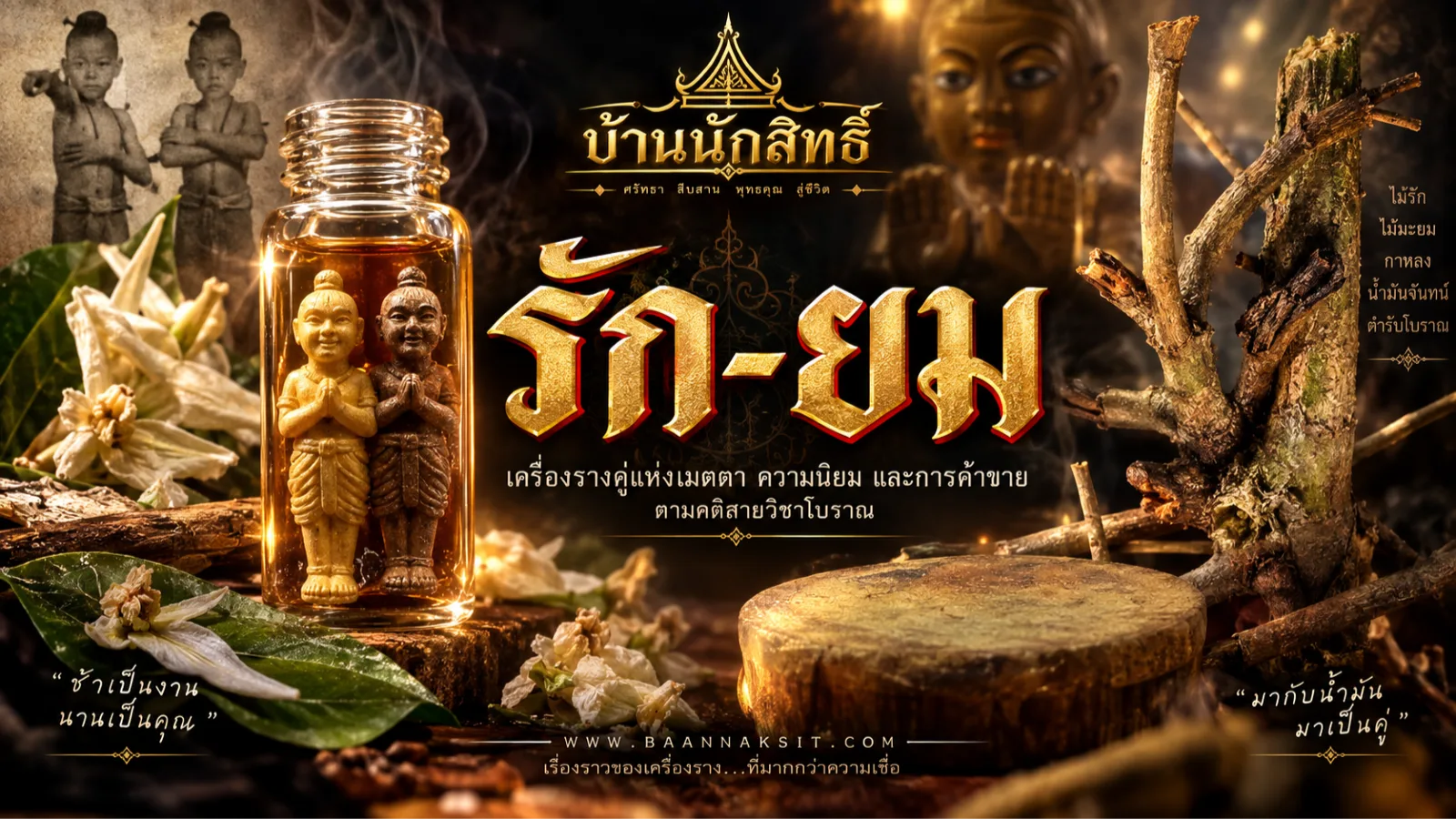
Rak-Yom (รักยม) was once among the most familiar sacred objects in Thailand. Traders carried a pair on their person, shopkeepers kept one beside the cash drawer, and you found them on market stalls and food carts alike. They were an ordinary sight for generations.
Yet ask what Rak-Yom actually is — how it differs from Kuman Thong (กุมารทอง), why it always comes as a pair, why it must sit in oil — and the answers scatter. Often they turn frightening.
I would like to tell the story from the beginning: from the master who passed the knowledge down, from the old texts, and from what I have seen with my own eyes.
The master who carried the knowledge
Luang Pu Pon (หลวงปู่พล) of Wat Wang Yai Hun (วัดวังยายหุ่น) was a monk of formidable concentration and deep learning. His Rak-Yom knowledge came down from Luang Pu Khruen Amaro (หลวงปู่ครื้น อมโร) of Wat Sangkho (วัดสังโฆ).
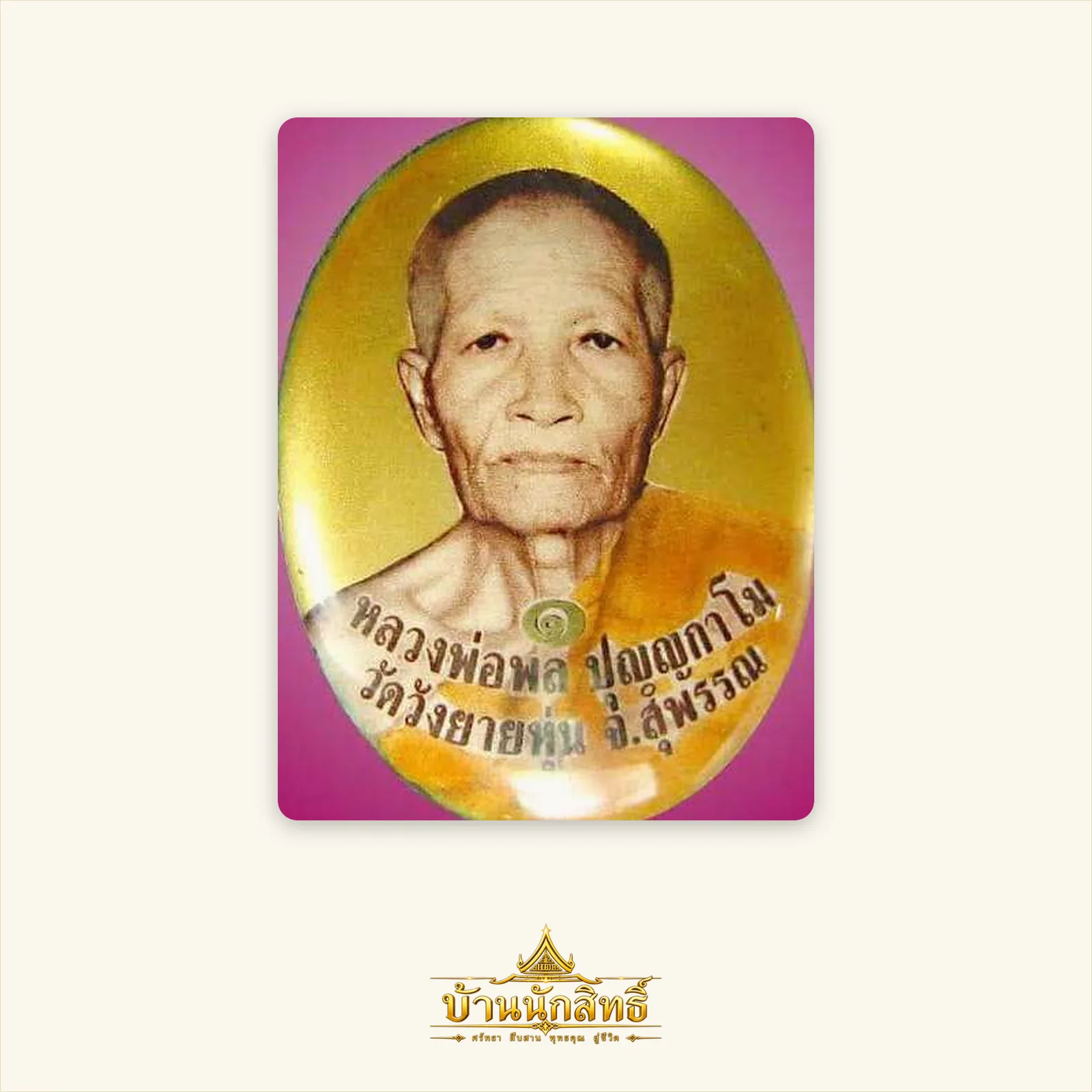
Luang Pho Pon Punyakamo (หลวงพ่อพล ปุญญกาโม), Wat Wang Yai Hun, Suphan Buri
I remember that on our very first visit we already witnessed something of his mind.
On the drive there I had been talking with Khun Chanphon about the reputation we had heard of, and about the practices I had my eye on. This one is good. That one is worth learning. But would he be willing to teach us?
When we finally sat down with him, the things we had discussed privately in the car — he seemed to know them along with us. The list of practices I had quietly set my heart on, he named them himself.
One I was particularly drawn to was Rak-Yom. He kindly explained it, and mentioned that the scented oil has to be consecrated separately as well.
The oil that rose out of the bottle
Phi N. produced the nine-scent oil he had brought with him and showed it to Luang Pho. He opened the cap, took in the scent, then settled his mind and breathed an incantation into it.
A moment later the oil seemed to foam, rising and spilling up over the mouth of the bottle. Several of us saw it and were startled. He took the oil that had risen and stroked it over Phi N.'s head.
It behaved like the head on a glass of beer swelling over the rim — not spilled, not knocked over.
That day we told Luang Pu we would find nine scented oils and make Rak-Yom for him to consecrate. He agreed. So we pooled our money and bought nine kinds of oil, without haggling over the price, as tradition requires, then blended and shared them out.
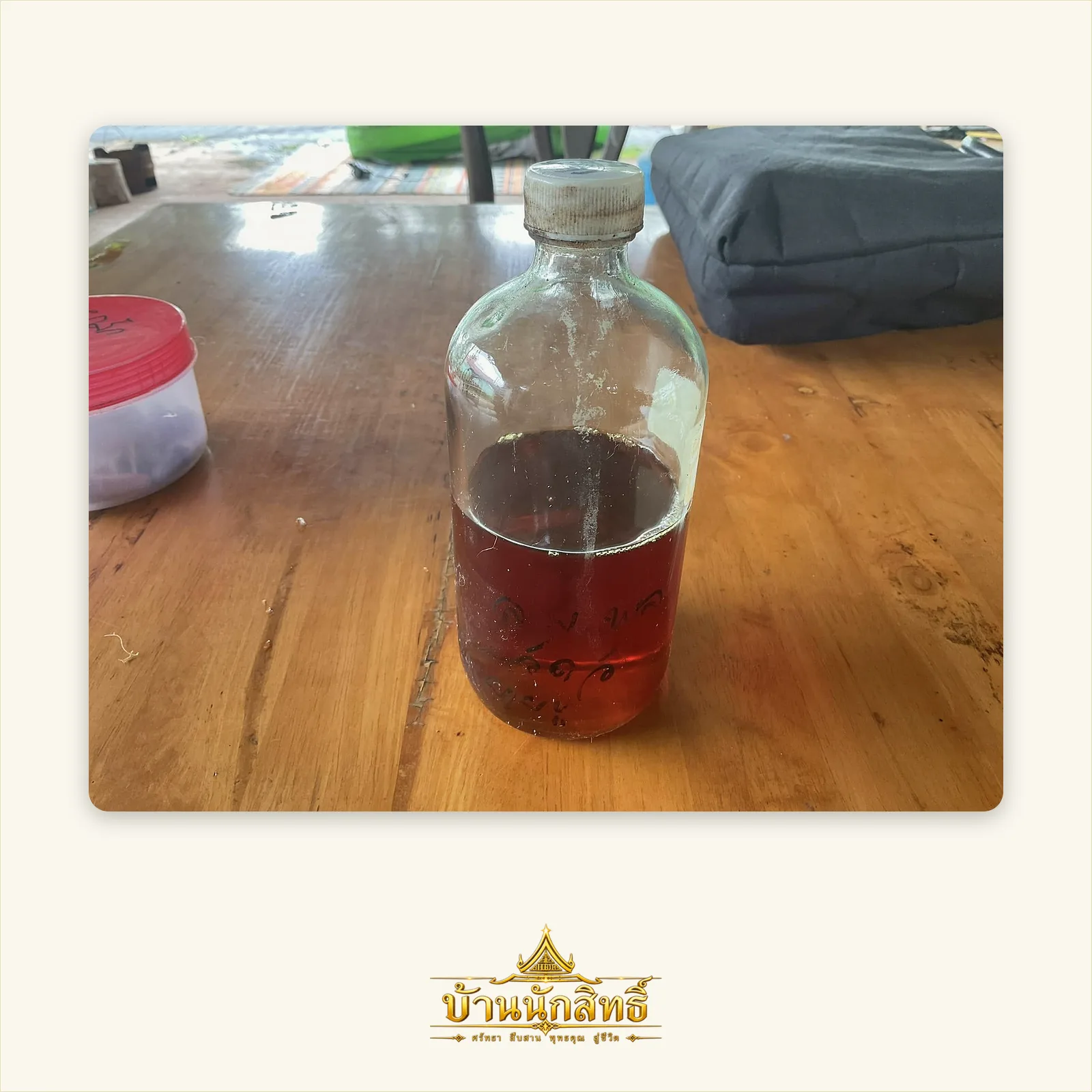
A bottle of oil Luang Pu consecrated — oil intended specifically for making Rak-Yom
What happened to Phi N.
On a later trip to the temple, Phi N. grumbled about something on the way.
Phi N. manages a student dormitory at a well-known university. He said that week had been strange. Young women, older women, students — all week they had been glancing at him sideways, smiling, making small talk, laying down bridges. As he put it: "It's not as if I'm all that handsome."
A friend travelling with us suddenly remembered, and pointed out — last week, Luang Pu stroked that oil over Phi N.'s head, and his alone.
It came back to him, and he raised his hands above his head in respect, because that was exactly how it had gone.
The oil that went through a palm
Another time I was at the temple writing takrut (ตะกรุด) to help Luang Pu. He was in good spirits and came to sit and watch. Someone brought him scented oil to look at.
He asked for an open hand, dipped a finger in the oil and anointed the palm, then blew across it once. He told the man to turn his hand over — and the oil had come through and was glistening on the back of the hand, plain to see.
So this is what mastery of the sacred powders looks like.
He laughed. "It's simple… only Namo Buddhaya."
He took a very long time over every sacred object he made. That is where I picked up my own habit of consecrating things at length — until I am sure, then sure again, and then sure some more. Following in the master's footsteps.
Rak-Yom — a wicked thing?
Good accounts of Rak-Yom have never been in short supply: its qualities in loving-kindness and trade, in swaying hearts, in making its presence felt. It became popular in a way that lived up to its name.
Then Rak-Yom began to be hawked at travelling sideshows. It grew so popular that sharp traders began turning them out of any cheap material, dropping them into counterfeit bottles of cheap oil, with no ceremony at all. Plenty of that followed.
But that is not as frightening as Rak-Yom made outside the tradition altogether.
There was a period — a gap between the generations of masters who held the old texts — when makers produced Rak-Yom simply to meet demand, by methods that were unclean. Frightening experiences with Rak-Yom followed from that.
That is where the whole catalogue of dark stories comes from, until keeping Rak-Yom came to be seen as keeping a ghost: little benefit, much harm.
Ja Bel and Ja Phan
I would like to tell one story that happened to people close to me.
In 2005, Bel was in his second year at the Air Force NCO school. He had loved sacred objects since childhood, which is how he became close to Ja Phan, a fellow northeasterner who was just as keen. Whenever they could get out of the school grounds, the two of them went hunting for good pieces.
One day they visited an amulet stall in Rangsit. Phan's eye was caught by a piece sitting in a bottle of sandalwood oil. The seller said he had only had this Rak-Yom for a few days, from its previous owner, who had become uneasy because his small child kept seeing children come to play.
So Phan invited it home, and said: "Come and stay with father. Let us make a living together."
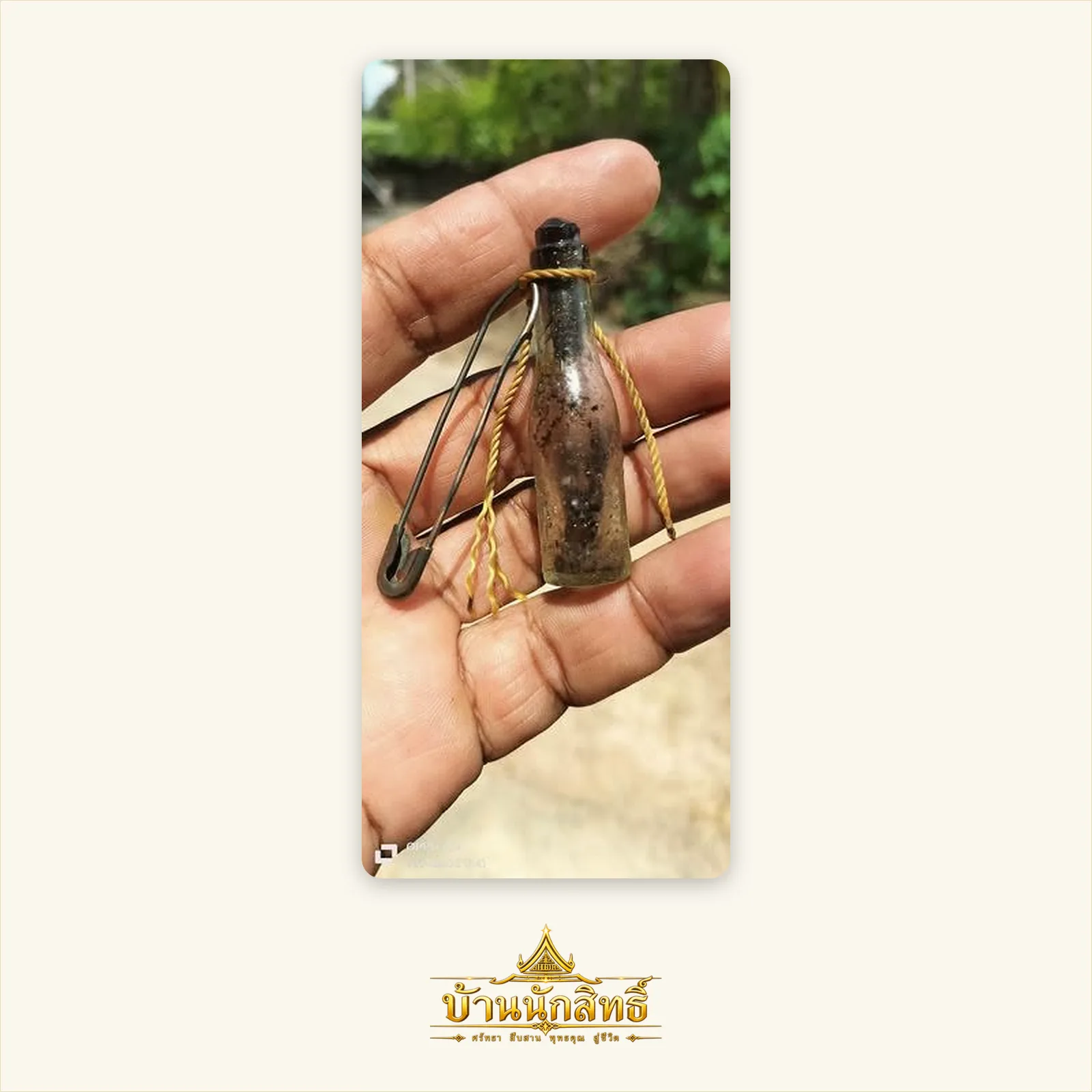
Rak-Yom bottles were usually bound with cord so they could be worn and carried on trading journeys
On that first day the two cadets went straight back to school for duty. Coming off his shift, as Phan was settling down to sleep half-listening to his Sound About, he saw a boy with a topknot walk up beside the bed and say, "Father, father, I've come to stay with you."
Phan took it for a dream and answered, "All right, all right, stay then. But don't bother father yet — I've just come off duty and I want to rest."
He was still drifting when the Sound About sounded again, and Phan realised it was no dream — the boy was still standing in front of him.
He came to his senses, took fright, scrambled up to the top bunk to Ja Bel, and stammered out that the Rak-Yom ghost had come.
Ja Bel observed that Rak-Yom comes as a pair, and that Phan must simply be exhausted and dwelling on it. He sent his friend back to bed.
Two minutes later the other boy came running, shouting, "Where's my father?"
Phan was badly shaken, and climbed up to sleep beside Ja Bel until morning.
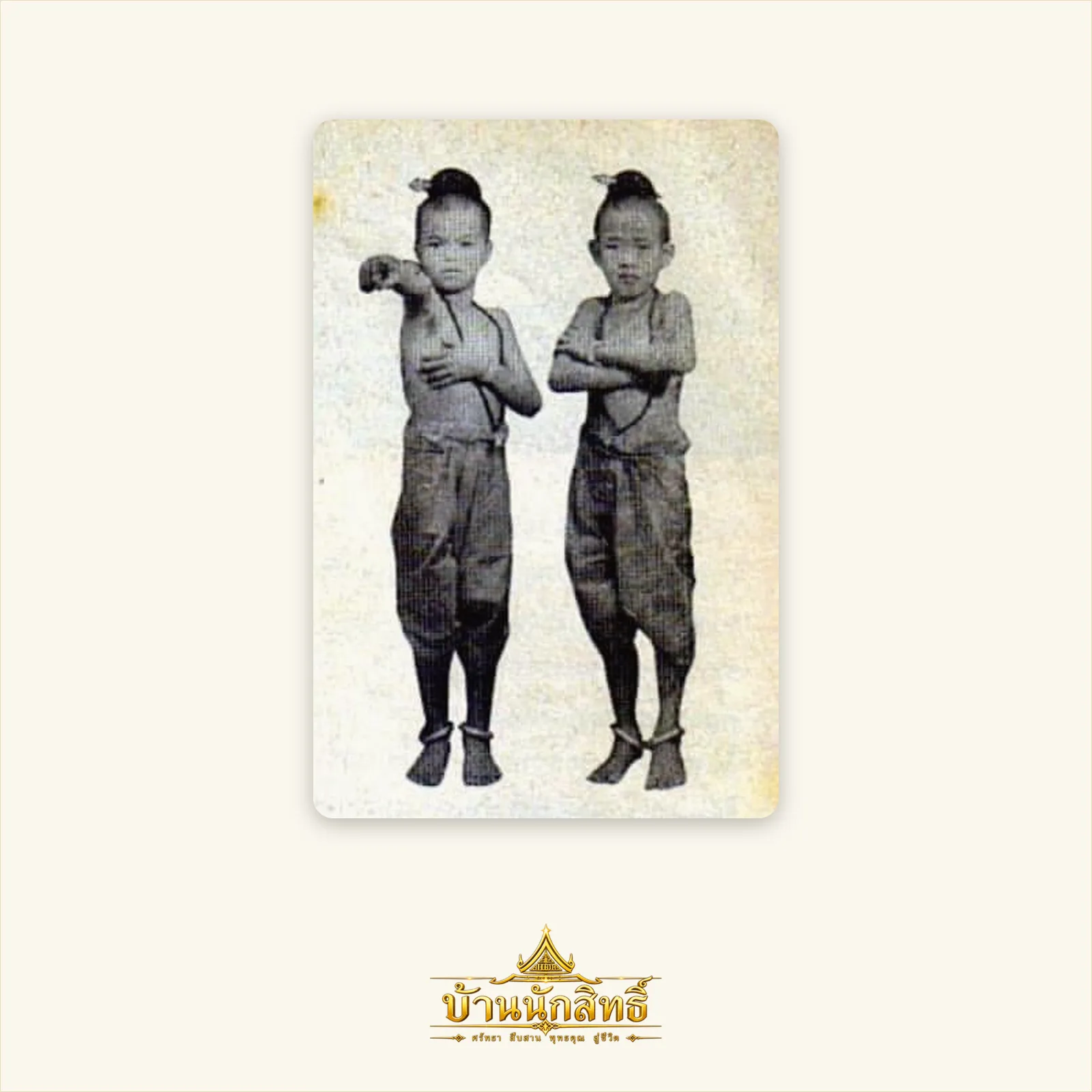
An old photograph of two boys with topknots — the form carvers have long used as their model for Rak-Yom
From then on people in the company kept seeing this pair of boys, with no one aware that the two friends had smuggled a Rak-Yom into the barracks. Some saw the children walking back and forth along the mosquito-net lines.
Ja Kiu was another. He used to slip away to telephone his girlfriend at one or two in the morning, and ran into the pair often enough that he went about telling everyone the company was haunted.
Word reached the duty sergeant, who called the company together and said that whoever was keeping something, or doing something, should get rid of it or stop, because it was frightening the others. But since no one knew where it had come from, the two friends went on quietly keeping that bottle until they graduated.
An ending less frightening than expected
Phan was posted to his home province. He looked after the Rak-Yom attentively, and took up trading on the side.
What surprised him most was that he had no experience of trading whatsoever. What he did was simply to tell his Rak-Yom children what he wanted — to sell more, and better, as time went on.
Today Ja Phan's business has grown considerably. He has expanded into a dormitory and a restaurant, drives an expensive car, and is comfortably off. He believes all of it came from the 250-baht bottle of Rak-Yom he invited home that day.
I asked around until I could form a reasonable idea of which master had made it. And from what I have been able to research, I find that Rak-Yom made according to the old texts carries no harm arising from the Rak-Yom itself. The more the keeper understands it and uses it sincerely, the more good comes of it — as it did for Ja Phan.
How Rak-Yom differs from Kuman Thong
This is a frequently asked question with many opinions behind it, and it can be answered from several angles. I would like to answer from a slightly different one.
I tend to work from symbolism, from the original texts, from the root — looking for the raison d'être, the reason the thing exists at all.
Rak-Yom and Kuman have this in common: both are treated as having a spirit.
Kuman Thong in its genuinely old form follows the tale of Khun Phaen (ขุนแผน) cutting the child from the womb of Nang Buakhli (นางบัวคลี่). A gentler version is the belief around luk krok (ลูกกรอก), the child born already departed. Both surely come from the same line of thought.
The "Tukkata Thong" text and guarding the house
Kuman Thong made as a figure for the altar, though, may be a relatively recent thing.
The model that looks oldest among them, and recent enough that its origin can still be traced, is the Kuman Thong of Luang Pho Te (หลวงพ่อเต๋) of Wat Sam Ngam (วัดสามง่าม). At first he made them from clay, in the shape of a doll. As they grew popular, other masters adapted the form in many directions, until eventually they were cast in metal.
His original text was the "Tukkata Thong" (ตุ๊กตาทอง), the golden doll, and its purpose was to guard the house and grounds. In its first form it therefore functioned much like a phayon (พยนต์), an animated guardian effigy. Once people came to feel its presence as a spirit, the use unfolded in many directions, and arrived at the Kuman Thong we know today.
What is clear is that this original Kuman was made to watch over house and garden, which is why it was set down in the place it guarded. And being clay, it was not durable — the neck broke easily — and its size made it unsuited to being carried. Later generations therefore called the spirit to travel with them instead.
Reading the hands
The Kuman of this lineage has a distinct form: both palms held out to the front, as if forbidding — do not come in.
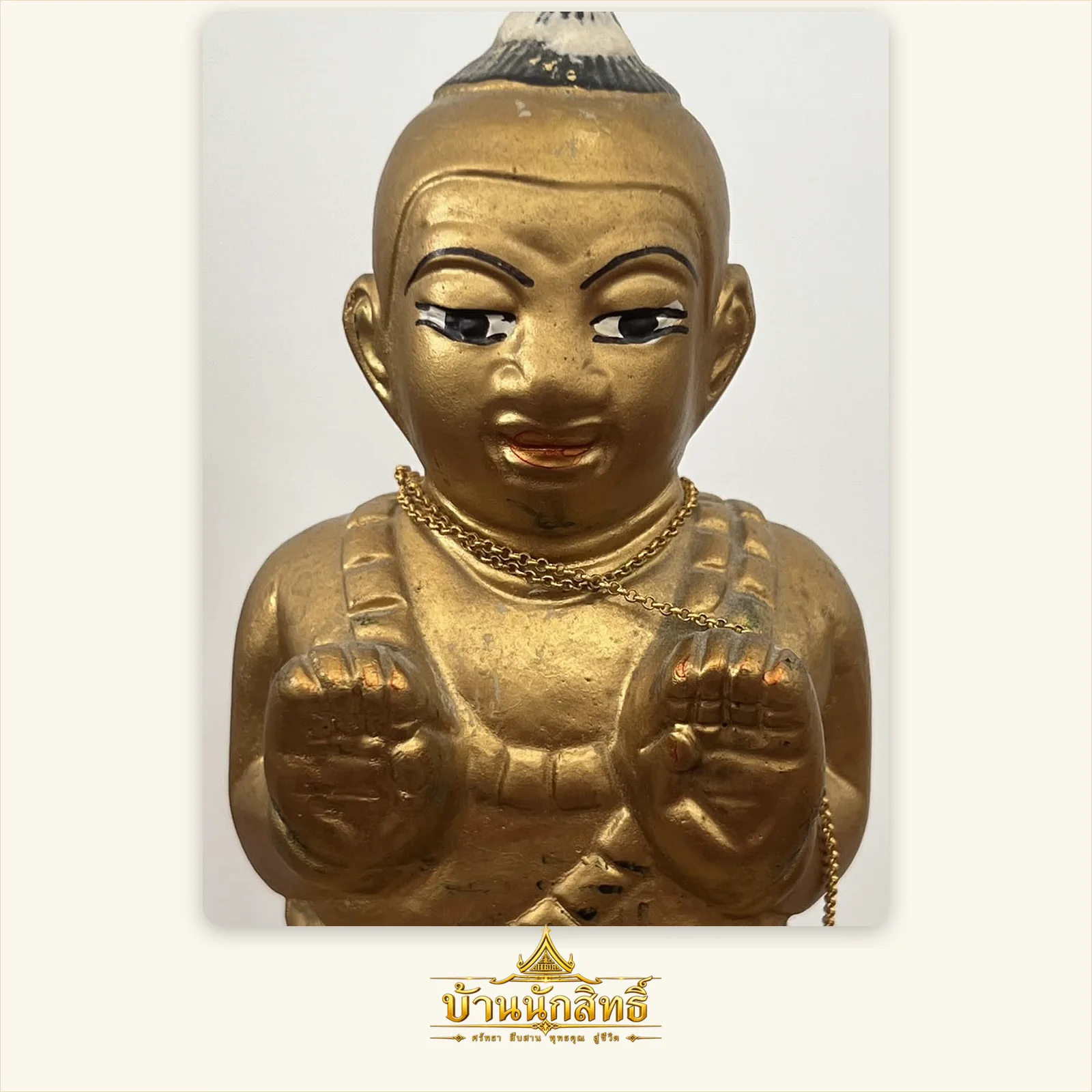
Kuman Thong with palms held forward — a gesture of refusal, the opposite of Nang Kwak, who beckons people in
The hands differ from those of Nang Kwak (นางกวัก), the beckoning lady — even within the same lineage — whose gesture calls people in, inviting them to come and buy.
And Rak-Yom?
Rak-Yom is wood, more durable, held in a small neat bottle with oil around it to prevent breakage. The purpose is to be carried, to travel and to trade — which is why the bottle is usually bound with cord for wearing.
The principal texts generally call for closed fists, "as though about to box" — a symbol of protection and defence, and possibly also the posture of an infant.
Set beside Rak wood, Yom wood and scented oil, the whole has been read in terms of love and popularity. (In Thai, rak means love, and yom echoes niyom, to be well-liked — the names of the two trees carry the meaning.)
I will not draw a conclusion here. Searching online, many people say Kuman is better for trade and Rak-Yom better for watching over a place. You may well hold that view, based on lived experience. For my part I would respectfully differ, for the reasons set out above.
The oil is the water of the womb
Rak-Yom resembles the In (อิ่น) in form: a pair of figures, and scented oil.
Rak-Yom also invites several further thoughts about the newborn human being.
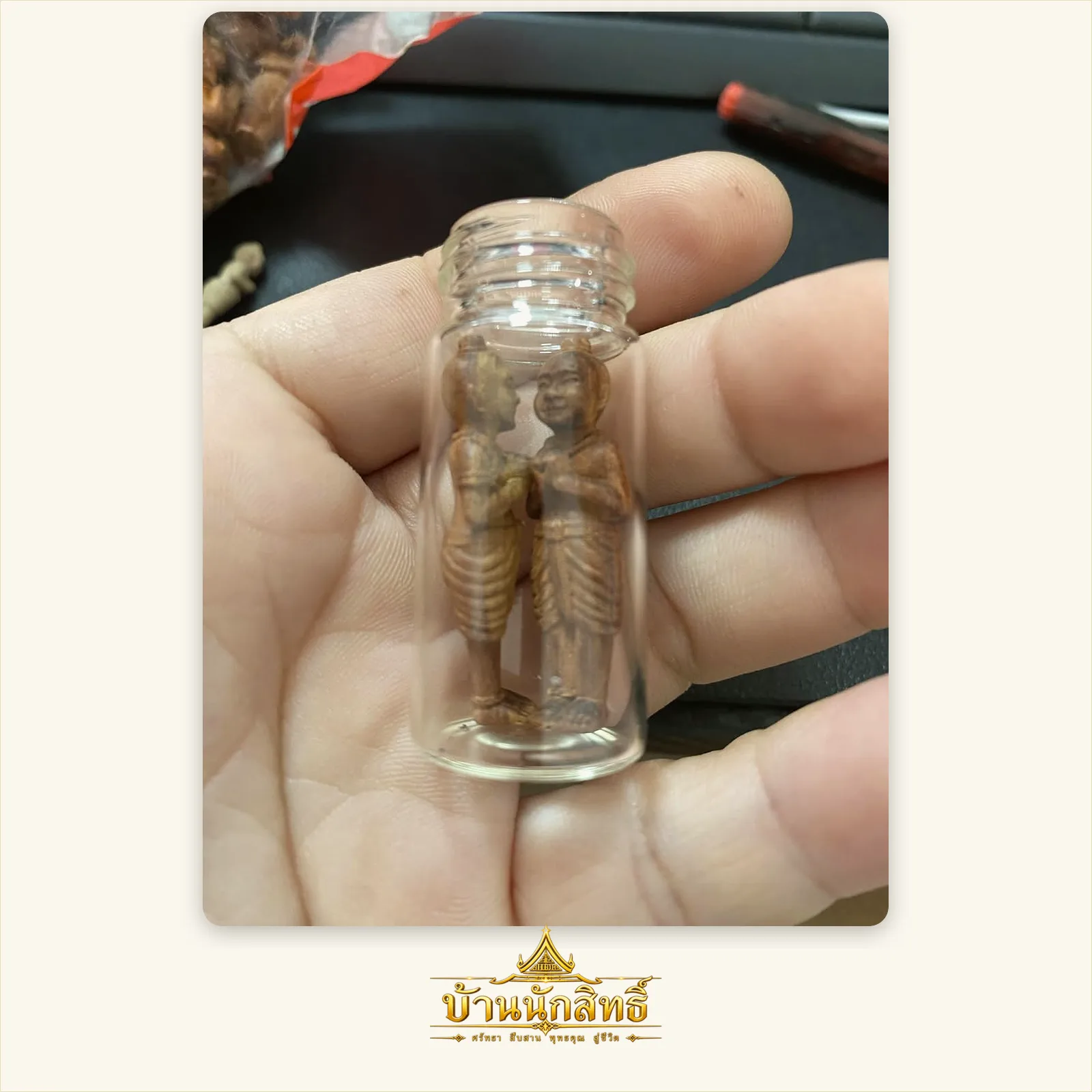
Two children in a bottle, waiting for the scented oil that will sustain them
Two children in oil. They wear the topknot and the wrapped cloth, yet their hands are still closed.
A child in the womb at full term lies curled with its fists beneath its chin, facing its mother's spine, with fluid all around sustaining it.
It is this oil that is used for anointing, for loving-kindness and charm.
There is another reason as well. Rak-Yom was meant to be carried out to trade, so oil was used to cushion it against knocks — just as the water of the womb shelters the child inside the mother.
The oil matters, then.
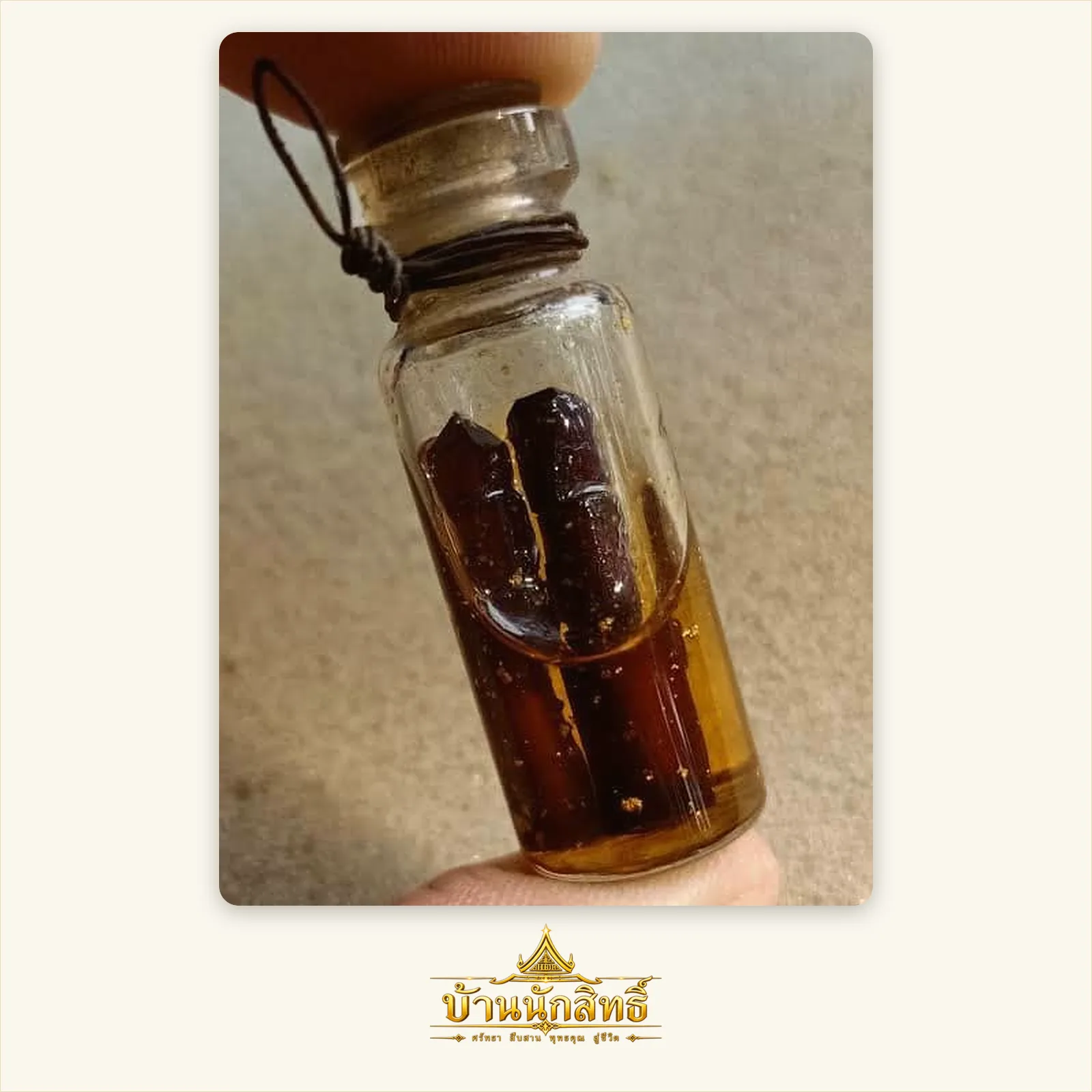
Rak-Yom steeped in oil — both cushioning, and the oil used for anointing
What goes into the oil
Whenever I am about to make a sacred object, I research it online first. The internet cannot give academically reliable information, but it does show what a society values, understands and expects — which way people's beliefs about Rak-Yom actually run.
The most visible point is that Rak-Yom comes as a pair, and comes with sandalwood oil. That scented oil can then be used for anointing, for loving-kindness and popularity — something Kuman does not have.
The oil steeps Rak-Yom, which is wood. So this time I wanted to compound the oil from wood as well — wood that inclines toward loving-kindness and good trade.
Kalong wood
Some years ago Phi Chiap came to visit me at home, bringing something rare: Kalong wood (ไม้กาหลง) from one of the significant Kalong trees named in the texts — and from the root, no less.
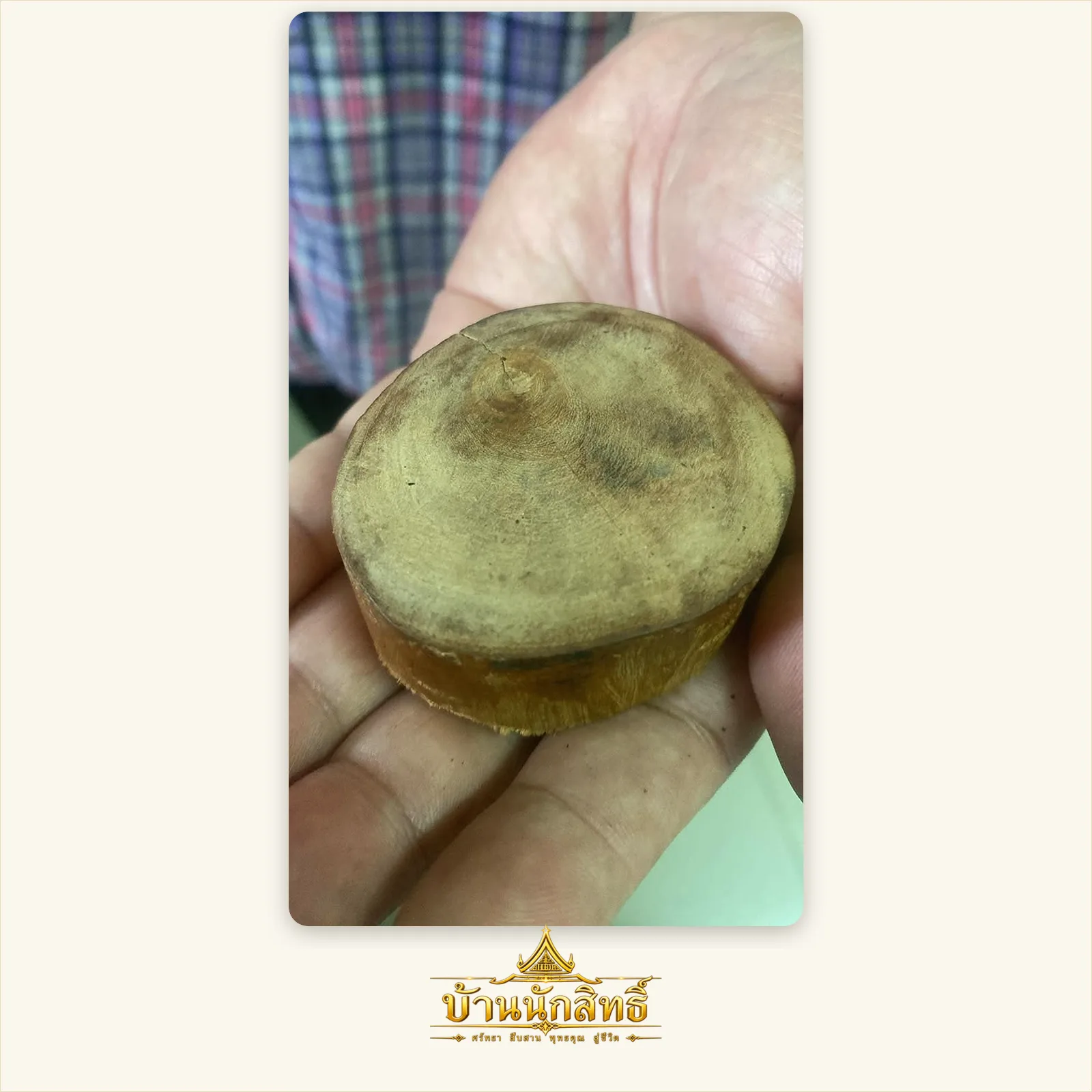
The cross-section of the Kalong wood I was given
Thirty years ago a Kalong tree was found in Kanchanaburi matching the description in the texts: birds and crows came and became so besotted with the tree that they stayed until they died, and their bodies lay scattered beneath it.
That tree was formidably potent. A master took wood from it to make sacred objects, and the accounts that followed made it famous at the time. Phi Chiap received his from a senior figure who had had the chance to keep some.
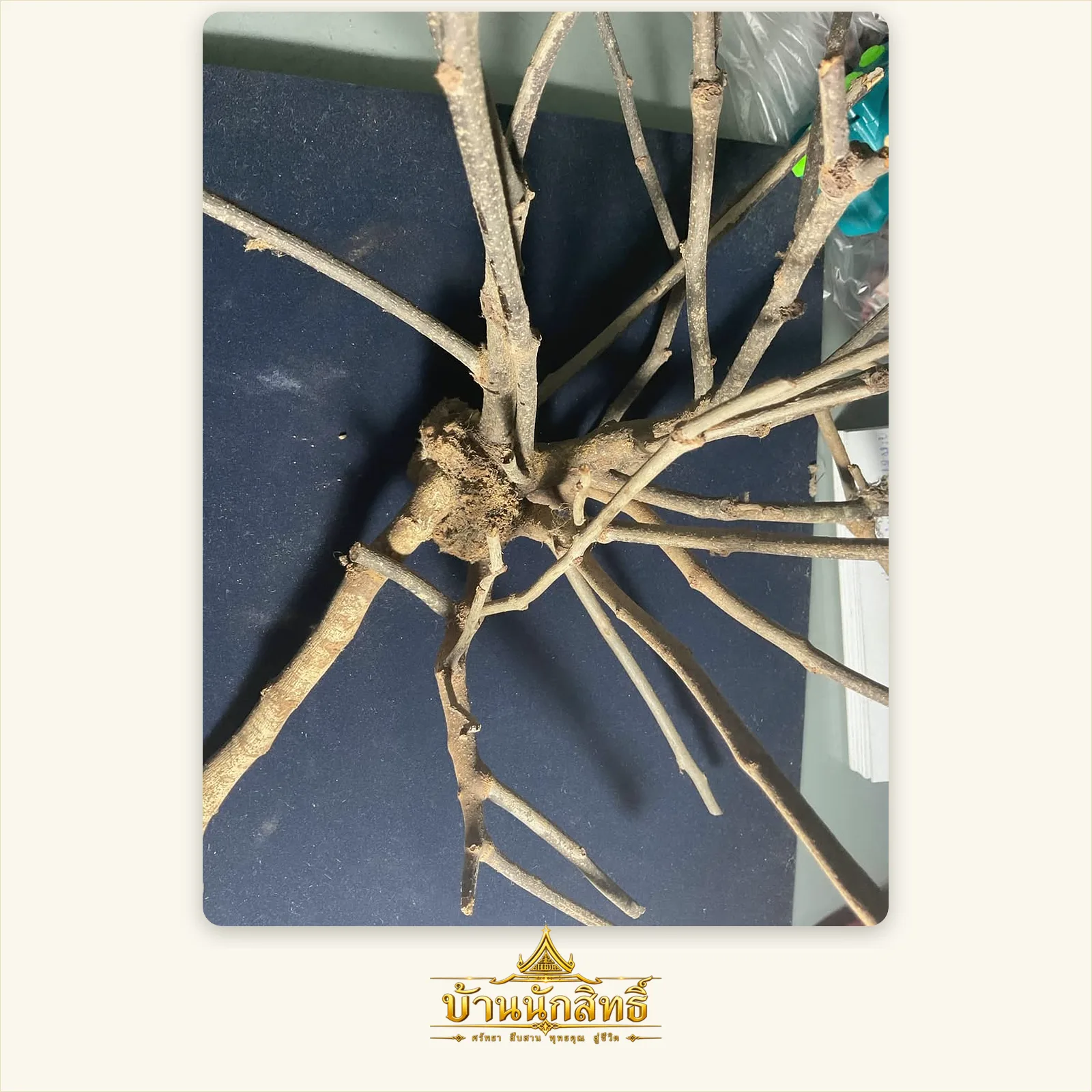
Kalong root — the part the texts single out
I accepted it thinking that I might, once in my life, get to make a "Thewa Kalong" (เทวากาหลง).
For Thewa Kalong, the Kalong wood is carved into a celestial woman and a celestial man and steeped in sandalwood oil — very much like Rak-Yom indeed.
So this time I have steeped that piece of Kalong wood in oil, consecrated with two incantations that carry qualities of loving-kindness and trade: Thep Ramluek (บทเทพรำลึก) and Thep Ranchuan (เทพรัญจวน). This is the oil used for making Thewa Kalong, and to my mind it can serve for consecrating Rak-Yom oil as well. There is no conflict, and nothing of the character is lost.
The four nurses
Once the principle was settled — that the oil should come from wood — I gave particular attention to what goes into the steeping. These are the ingredients:
Kalong wood, from the tree described above
Rak Son wood from a tree that died standing
Yom wood from a tree that died standing
Flowers and leaves of Rak Son
Parasitic growths from Rak, Yom, Moringa and Kalong
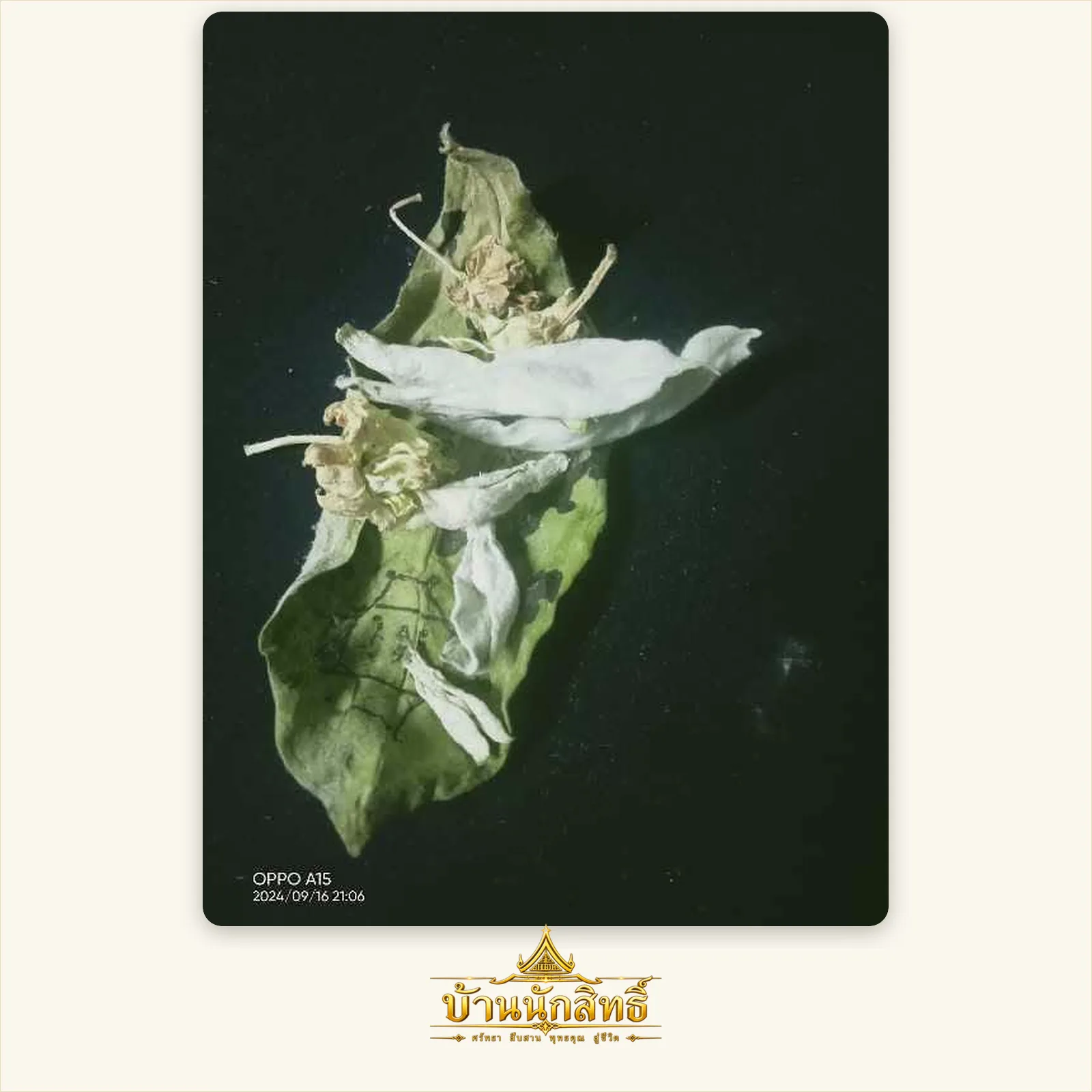
Flowers and leaves of Rak Son
Four parasitic growths, no more — standing for the four nurses.
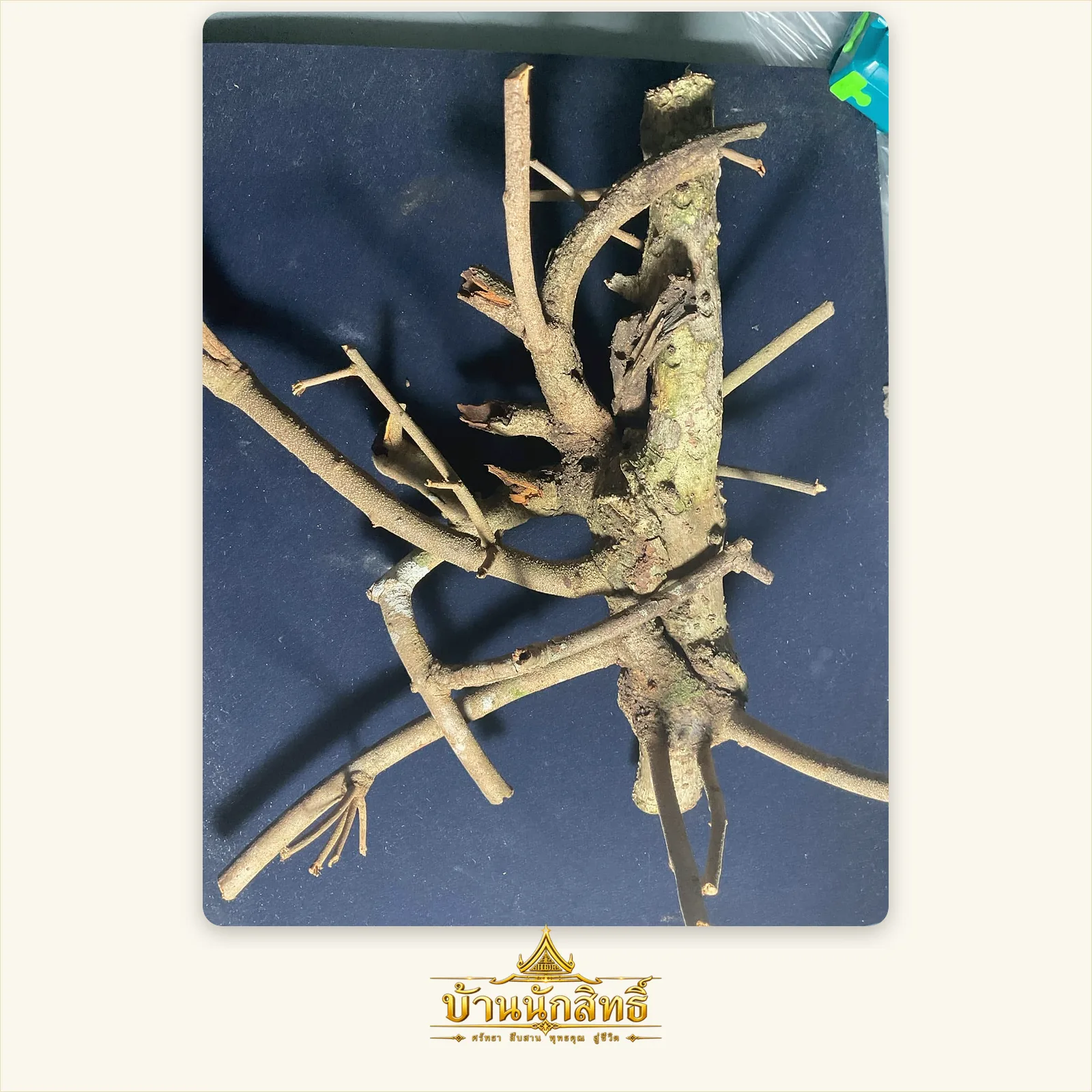
A branch carrying a parasitic growth — one of the ingredients steeped in the oil
You can begin to see the pattern: the old masters consecrated the Rak and Yom figures, and the scented oil, as two separate matters.
So is Rak-Yom a ghost, or a deity?
Another common question: is Rak-Yom a ghost, a deity, or what exactly — what is certain is that it is wood.
Let me first consider whether I ought to hold an opinion at all. Some things are for telling, and some are better left in silence.
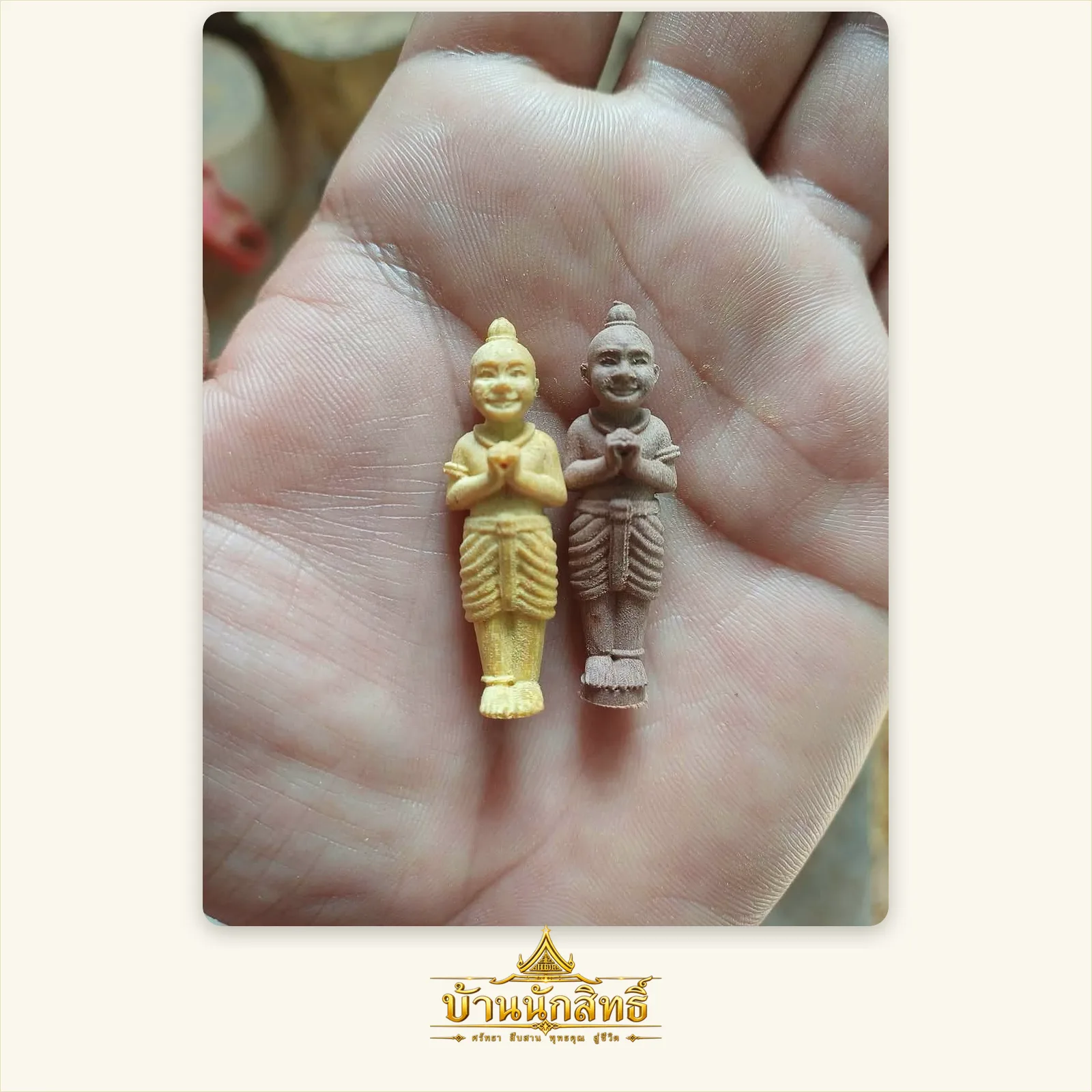
A pair of Rak-Yom — a sight familiar to Thai people for generations
In our age we take up these things with little sense of where they came from. But it does let us watch belief develop as it goes.
Perhaps, sometimes, imagination matters more… it may well be so.
Note: the accounts and experiences in this article are what the author has witnessed and has been told, recorded as they were given. Nothing here is offered as a guarantee of any result.