Ai Kamphra Wua Thanu — the bull for trade and contest
11/09/2026
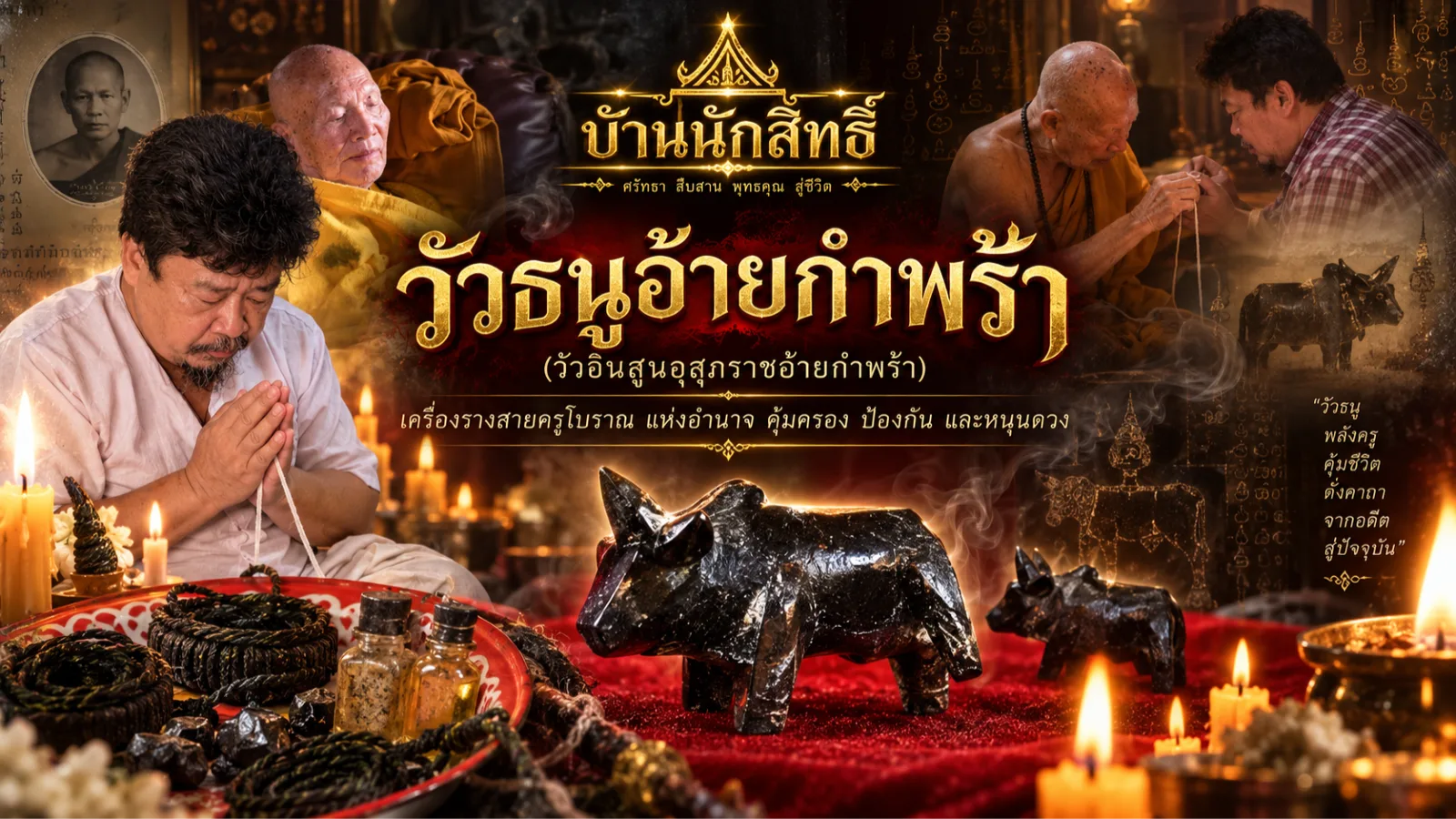
The Wua Thanu (วัวธนู), the sacred bull, is a charm whose name every Isan native knows well. But ask further — how many textual traditions are there, how do they differ, and what did the masters intend each to be used for — and few can answer.
In this article I will speak of yet another Wua Thanu tradition, the one called "Ai Kamphra" (อ้ายกำพร้า): its origin in folk tale, the masters through whom the knowledge came down, the day the lineage was placed in my hands, and the instructions for use as the texts give them.
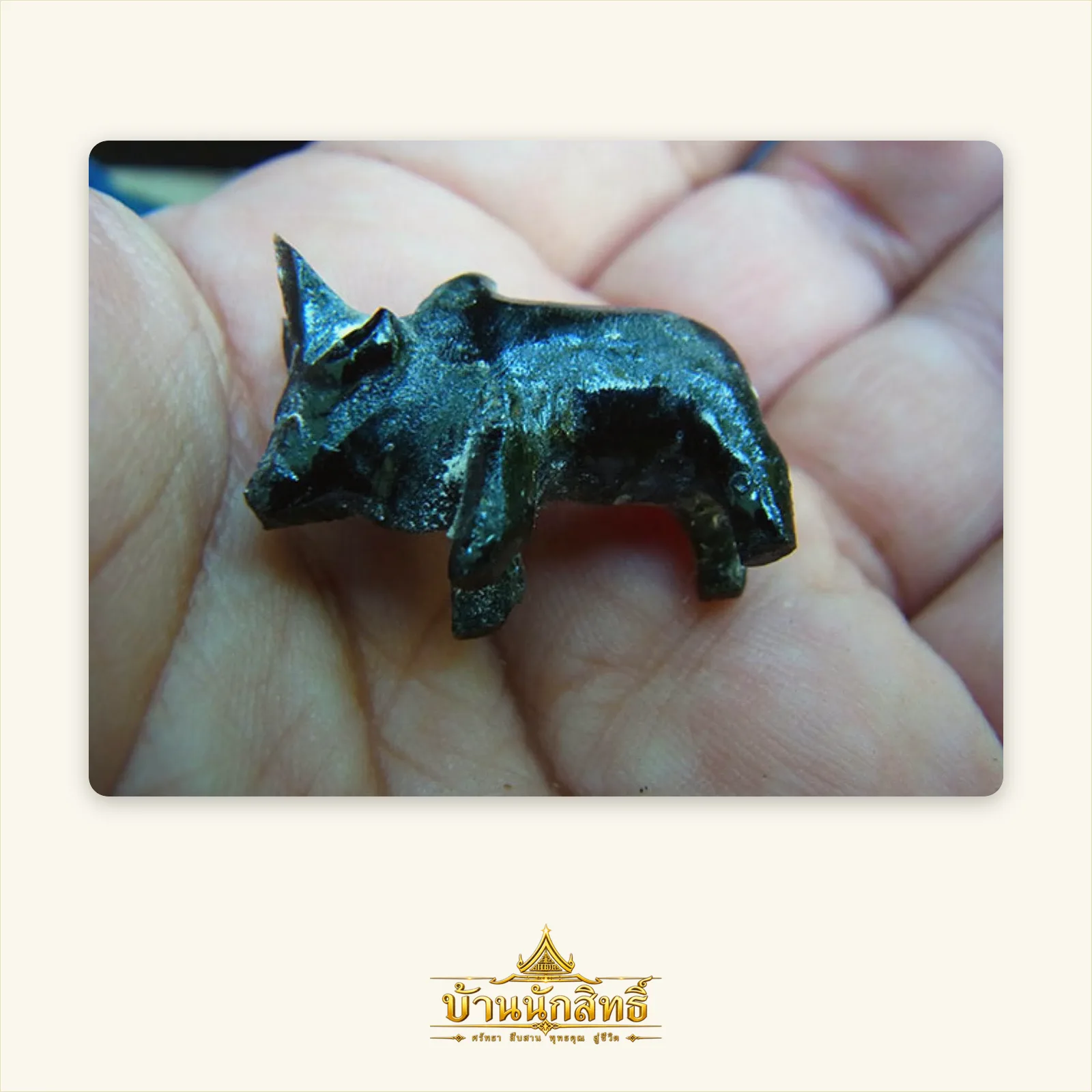
Wua Thanu carved from horn, Ai Kamphra tradition — sized to fit the palm
A bull for trade and for contest
This is another Wua Thanu tradition favoured since old times, widespread through Isan, Lan Chang and Lanna.
I once carved bull horn in this tradition and offered it to Luang Pu Ya Than Phao (หลวงปู่ญาท่านเภา), who kindly consecrated them for our own use. It is a Wua Thanu worth carrying, because this tradition is directed toward trade and competition.
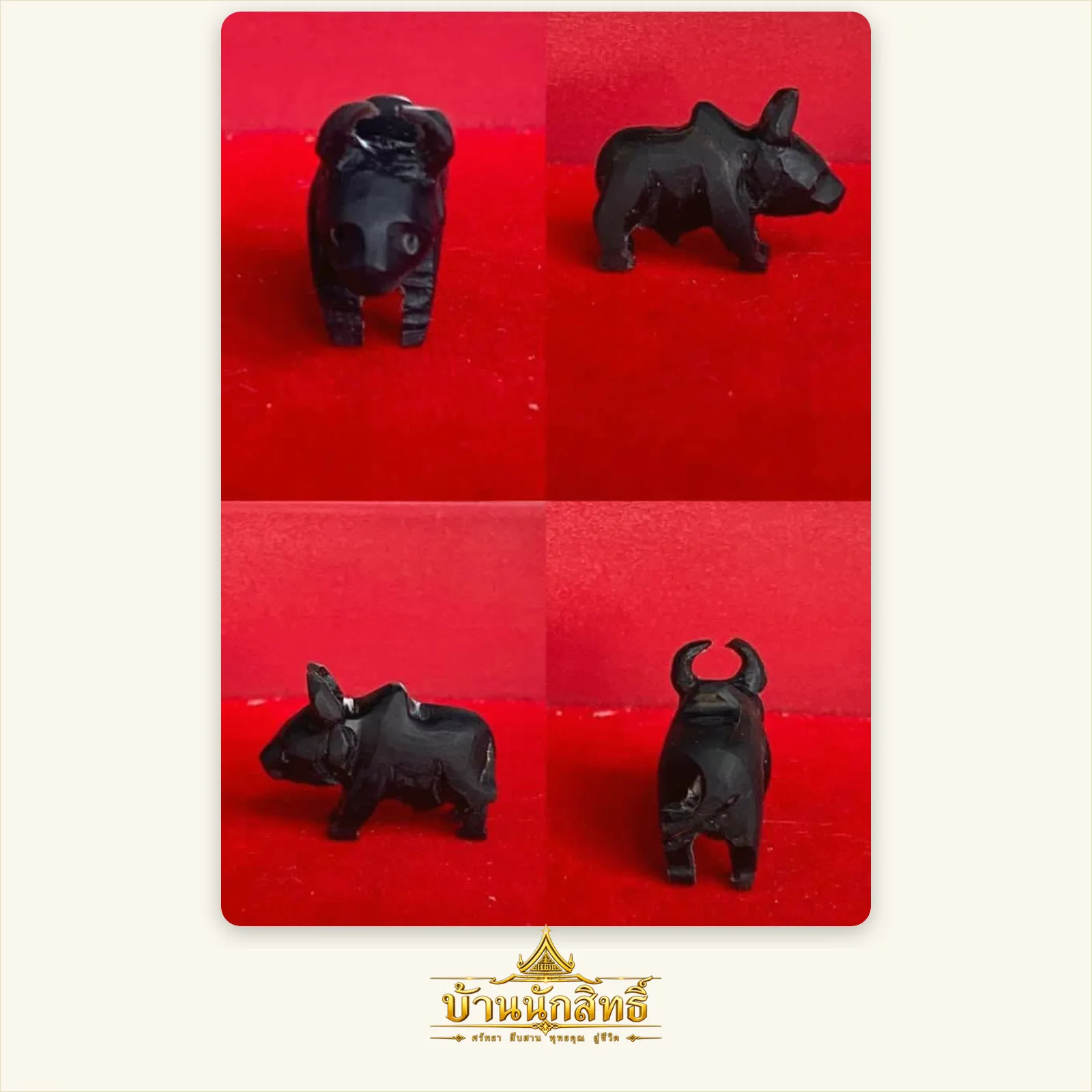
Seen all round — head, body, horns and stance
This year the economy does not look well. I thought of bringing out the "Ai Kamphra" Wua Thanu, which seems fitting for a time of hardship and high prices.
In truth I had wanted to make the Wua Phan Chong, 4th edition, as a complete set. But then I considered that the Ai Kamphra Wua Thanu has hardly been made by anyone these past four or five years, and even when it was made, it was promoted as a bull for subduing — so its principal flavour was lost.
Although this tradition does not require it to be made on a Tuesday full moon, the Tuesday full moon has by now become my own personal occasion for making Wua Thanu.
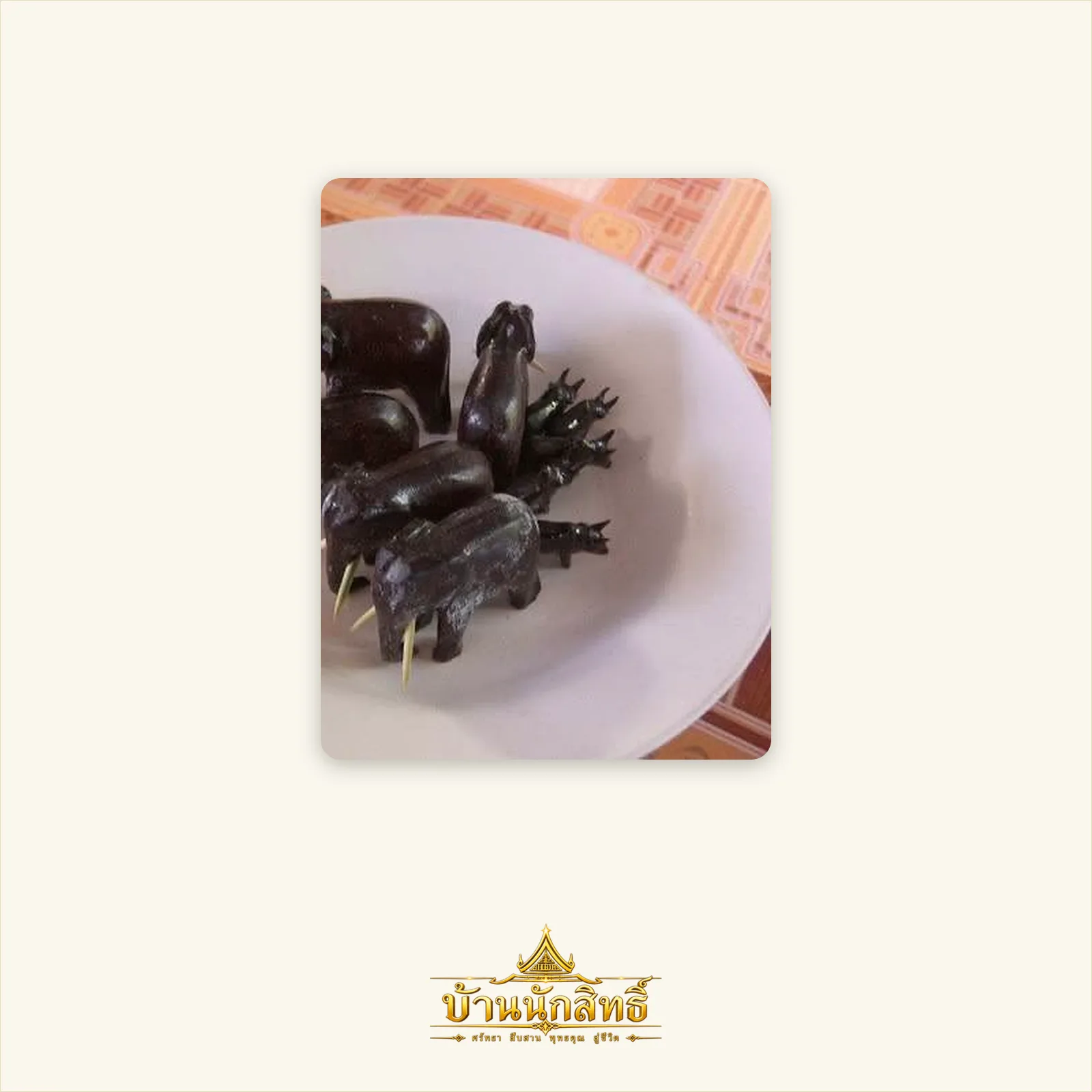
Carving finished, awaiting the ceremony
Where the name comes from — Thao Kamphra Phi Noi
As to why it is called "Ai Kamphra", the masters explain that it is the Wua Thanu of Thao Kamphra Phi Noi (ท้าวกำพร้าผีน้อย), the hero of the folk tale of the same name, a story long told by word of mouth.
The first time I heard it was from the monk who taught moral instruction at school. He had his teaching method: if we were not unruly, he would tell us the story at the end of the hour. He divided it into five instalments, and every one of us in the room turned into a good child, quite hooked.
A little of the tale should be told, so that one can see what makes this bull good. Allow me to give the abridged version as our moral-instruction teacher told it; there are many versions, and what one reads differs from one telling to another.
The tale in brief
Tales such as this were gathered in as non-canonical Jātaka — instructive stories held to be former lives of the Buddha.
In that life he was born as Thao Kamphra, a poor child without father or mother, plain of face, whom the villagers disdained; so they tricked him into farming land haunted by fierce spirits.
There he met the old woman who watched the orchard — in some versions a spirit, in others an old woman who kept the king's orchard. This last is the version always favoured for telling in the courtly, dynastic style.
The old orchard-keeper pulled out a diamond hair and gave it to Thao Kamphra, a marvellous thing that could be made into a snare for catching animals.
At that time the rice and the field crops bore fruit and grain abundantly, and their scent drew all manner of creatures; fish traps were set, and the fish were stolen. So Kamphra laid the snare to catch the thief, and caught a succession of animals.
The first taken in the snare was the bull Usuparaj (the name recurs constantly — wherever there is a bull, this name is used). The bull begged for its life, and so gave up its horn, declaring it a thing of increase and prosperity.
The second was an elephant. The elephant pleaded, and gave up its tusk. In this tusk dwelt the heroine (as in the tale of Sano Noi Ruean Ngam), who came in secret to wait upon the hero. The hero caught her out, smashed the tusk, and took her to wife.
The third was a civet.
The fourth was a tiger.
The fifth was a nāga — some say a garuda, some a water elephant.
The last was Phi Noi, the little spirit, who thus became his attendant.
Possessing these things of increase, Thao Kamphra grew wealthy. Word of his beautiful wife reached the king's ear, and the king desired to take the lady of the tusk for his own; so he devised a series of wagers and contests, staking the city against the wife.
In the cockfight, the civet transformed itself and fought, biting through the other bird's neck.
In the bullfight, the tiger transformed itself and met the bull, striking in secret until the king's bull was dead.
In the boat race, the Phaya Nāga came to compete, and devoured the men and the king himself, so that he was defeated.
The king's death has a sequel. The king's ghost had a flying lemur summoned to call away the soul of the lady of the tusk, that she might die. Thao Kamphra and Phi Noi undid it, and cut out the lemur's tongue — which is why the flying lemur has no tongue, and its tongue became the betel leaf.
And in some lineages of practice, the tiny tongue of the flying lemur is made into a charm used for calling back the soul, such as rings and takrut. (If anyone has a lemur's tongue, I would gladly make them up for us to share.)
In the end the two lived long in love together…
The tale should not be hard to find — the rendering by Thammakhan, for instance; Isan scholars have published it in several versions.
And where does the bull horn come in?
The bull horn — in no version of the story is it taken and carved into a bull. That must be oral instruction within the lineage. Since it is the horn the bull gave up of itself, some lineages use horn that has been shed naturally.
Ya Than Phao used naturally shed horn in practice; the text itself says only that horn is to be pared into the form of a Wua Thanu.
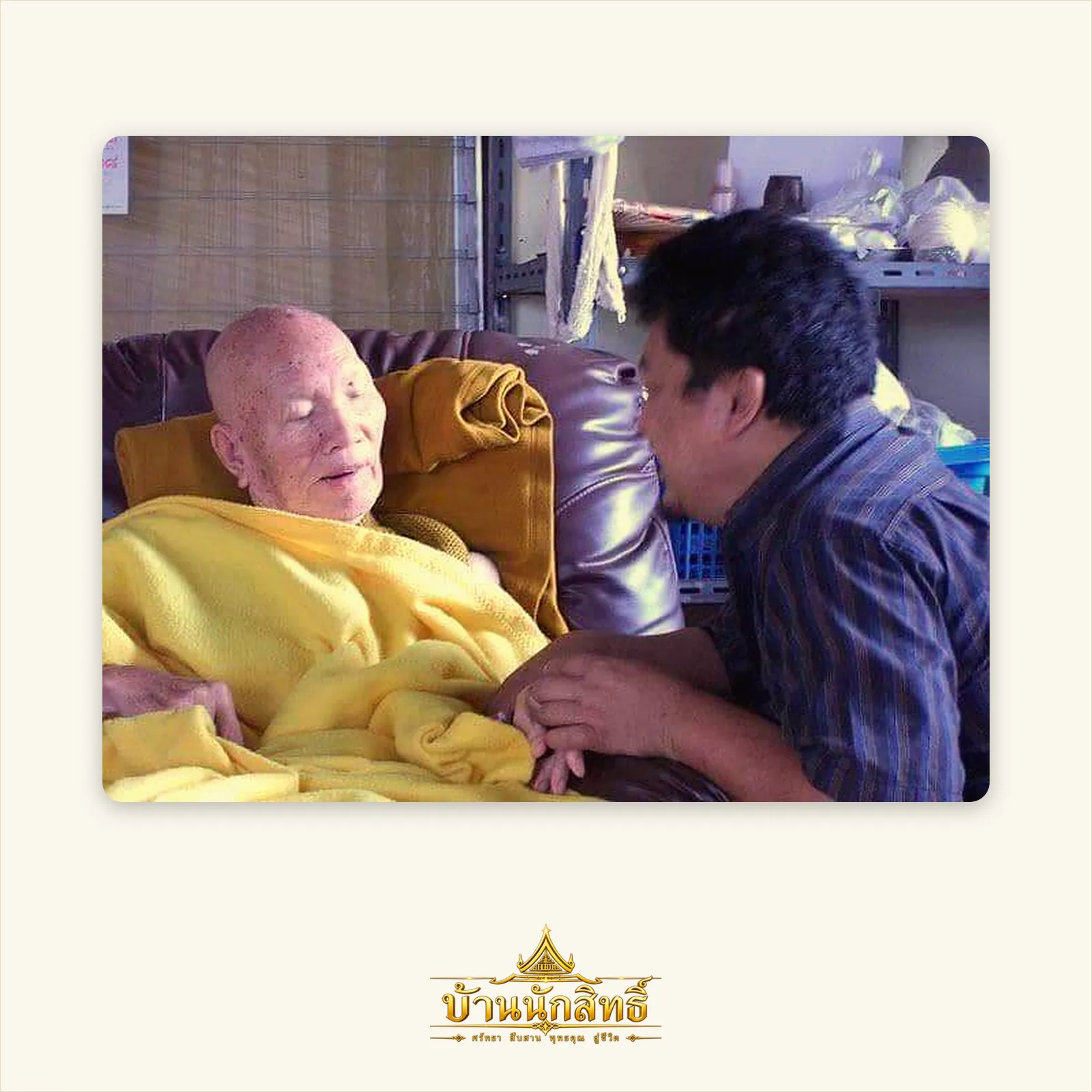
The day I went to pay respects to my master
Several renderings of the text are found; we hold to our own lineage, naturally — at the very least I have sat in consecration together with him.
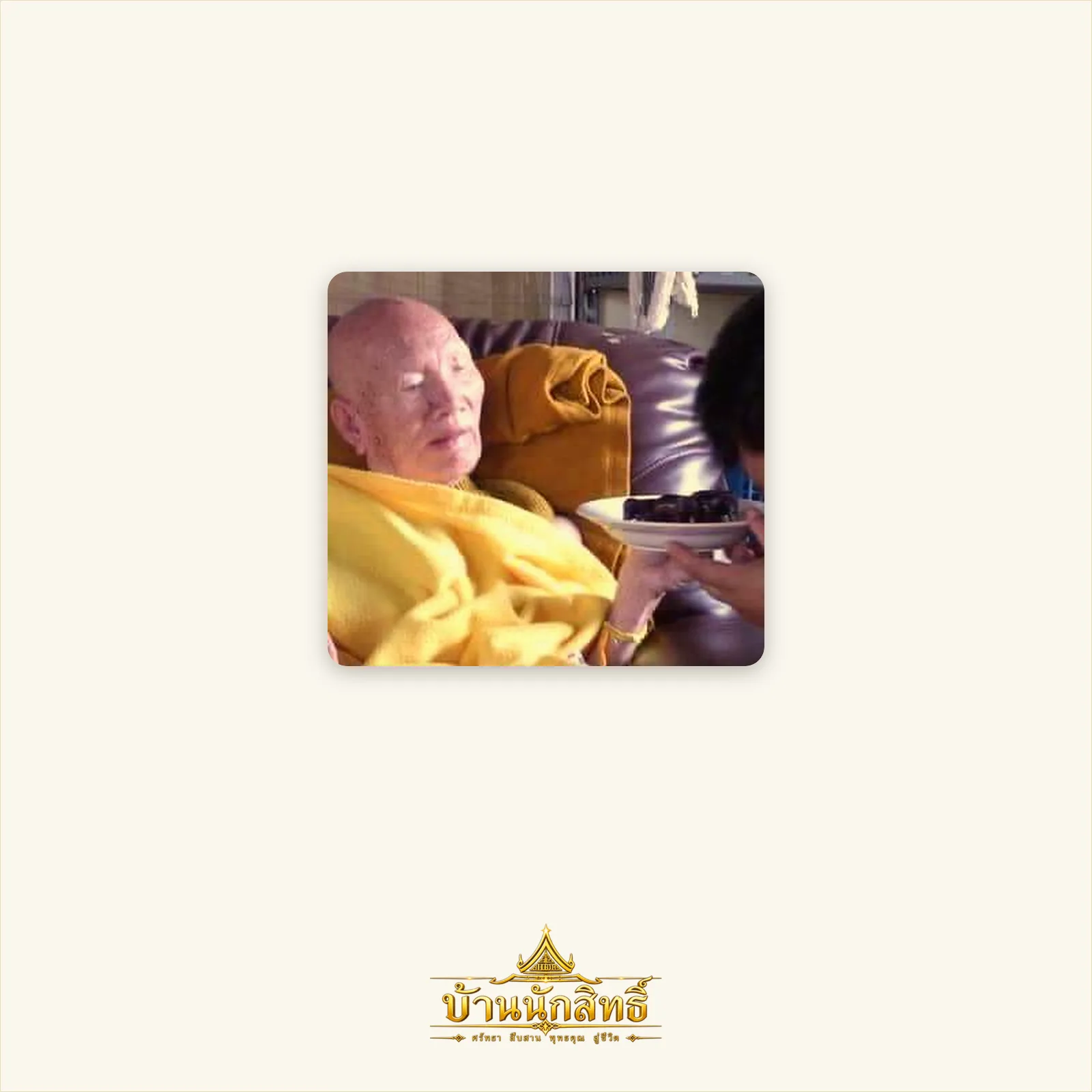
Offering the Wua Thanu for his kind consecration
By now one can perhaps see… in what way it is good for contest.
Receiving the lineage from the master's hand
This is the first time I have issued the horn bull of this tradition under my own name. But in my younger years I knew the renown of this knowledge, and I once sought out sacred ingredients for that making.
The day of boiling the Itthaje beeswax
That day I boiled Itthaje see phueng (beeswax pomade), with Ajarn Uan (อ.อ้วน), the foremost disciple of Ya Than Phao, helping me.
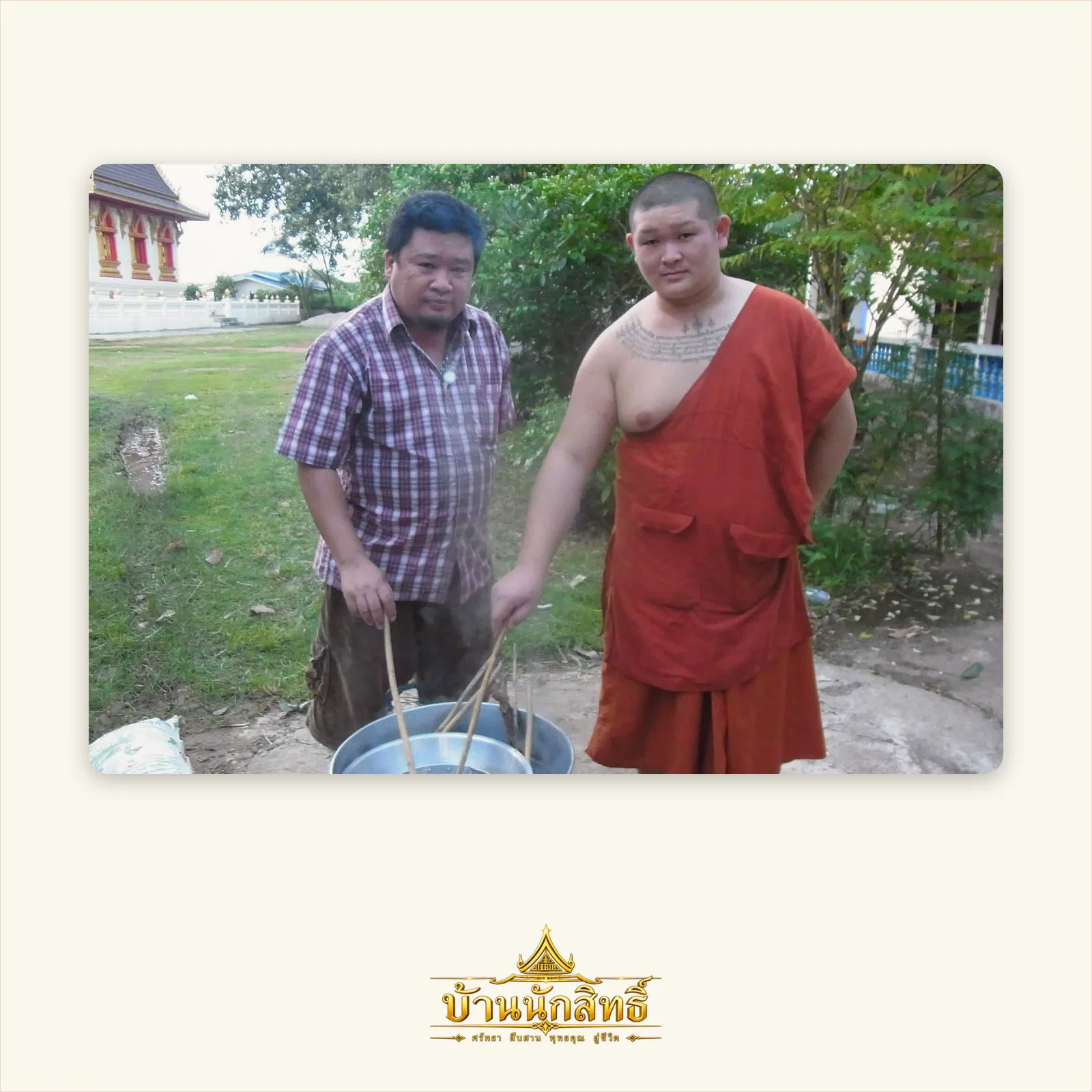
The day of boiling the Itthaje beeswax
At nightfall I raised the tray — Wua Thanu, water elephants, 108 takrut, horn bulls — and requested that he consecrate them at his altar.
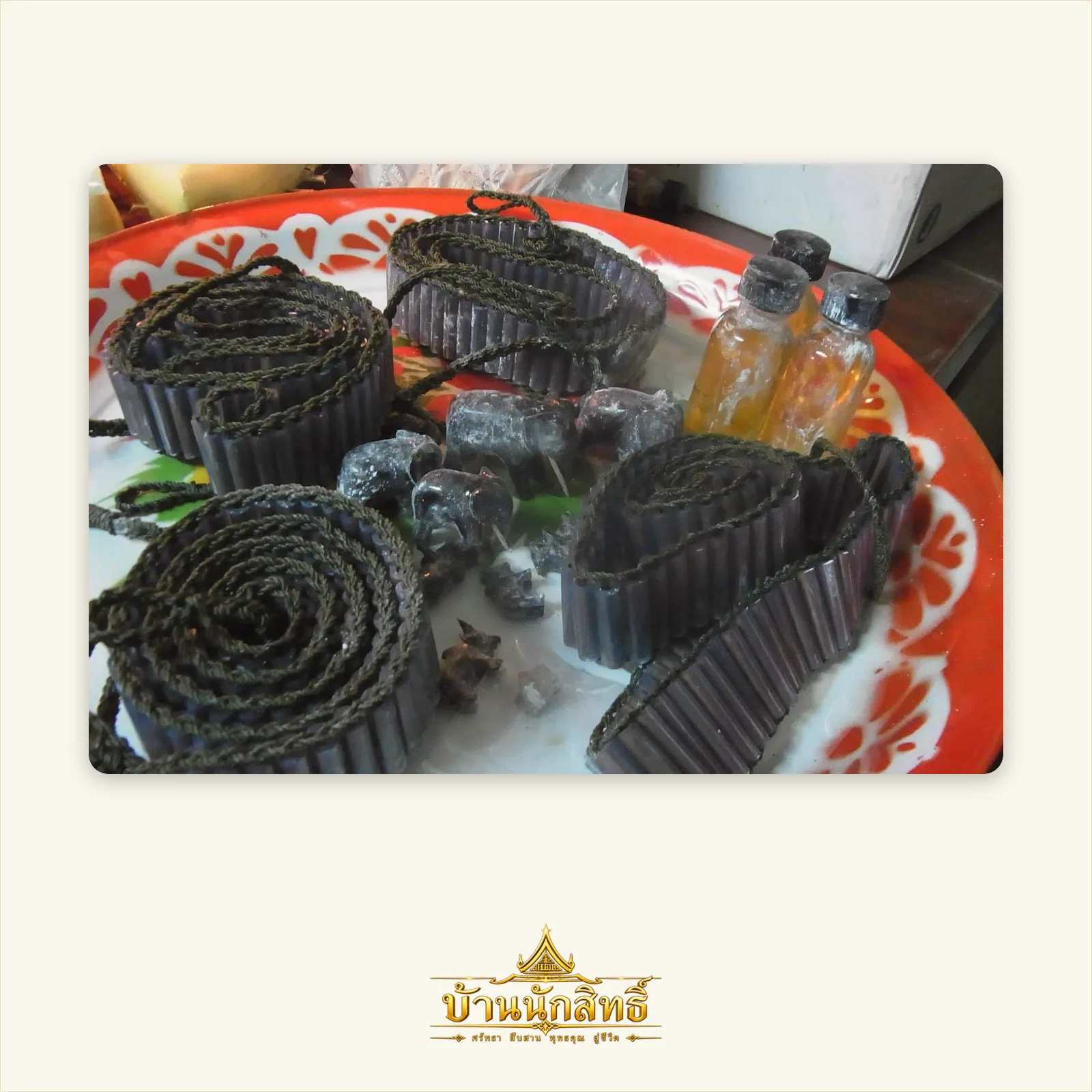
What was raised upon the tray — 108 takrut, Wua Thanu, water elephants and oil
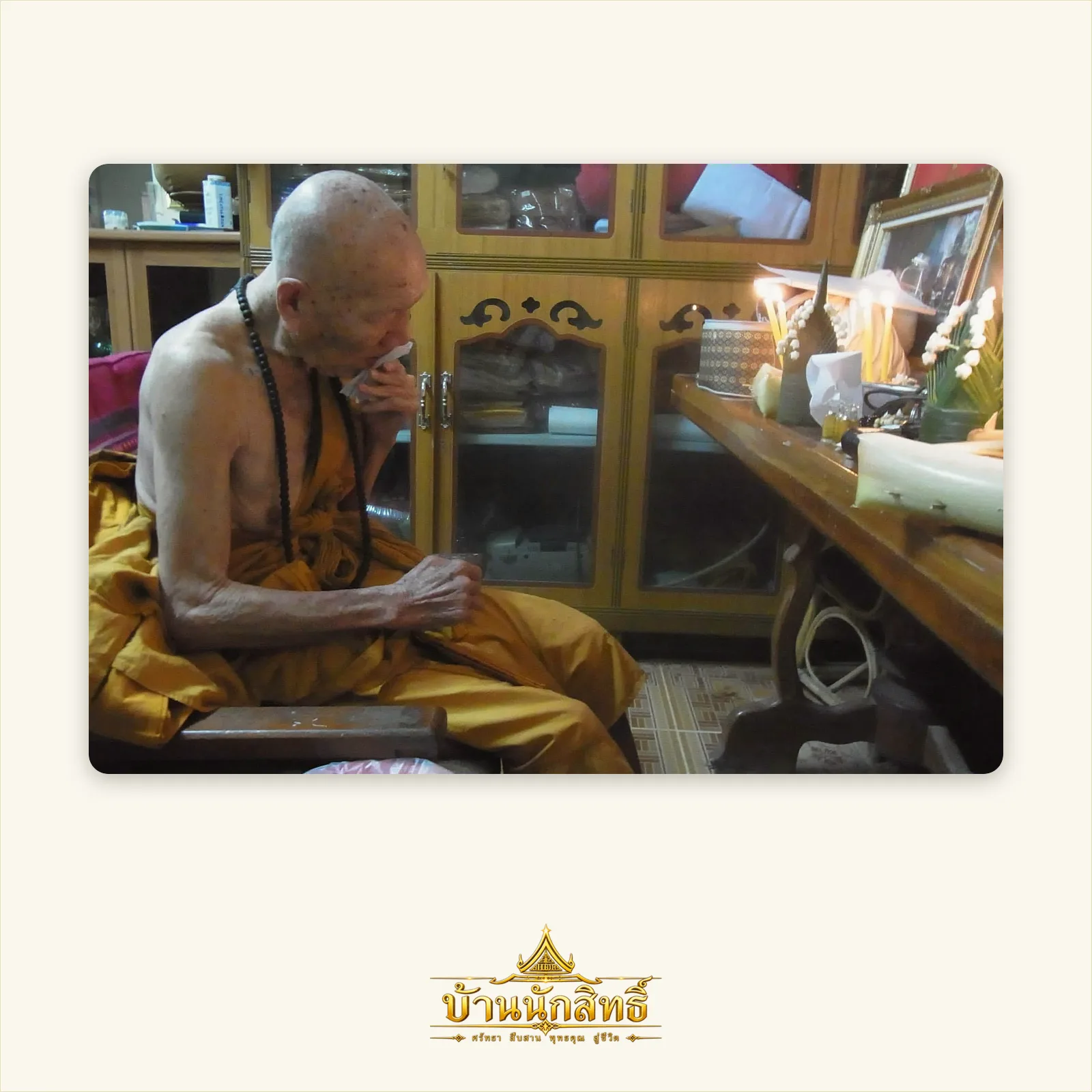
His altar
I sat waiting on the floor. Ajarn Uan drew the sai sin thread over and placed it in my hands, saying — Luang Pu bids you consecrate as well.
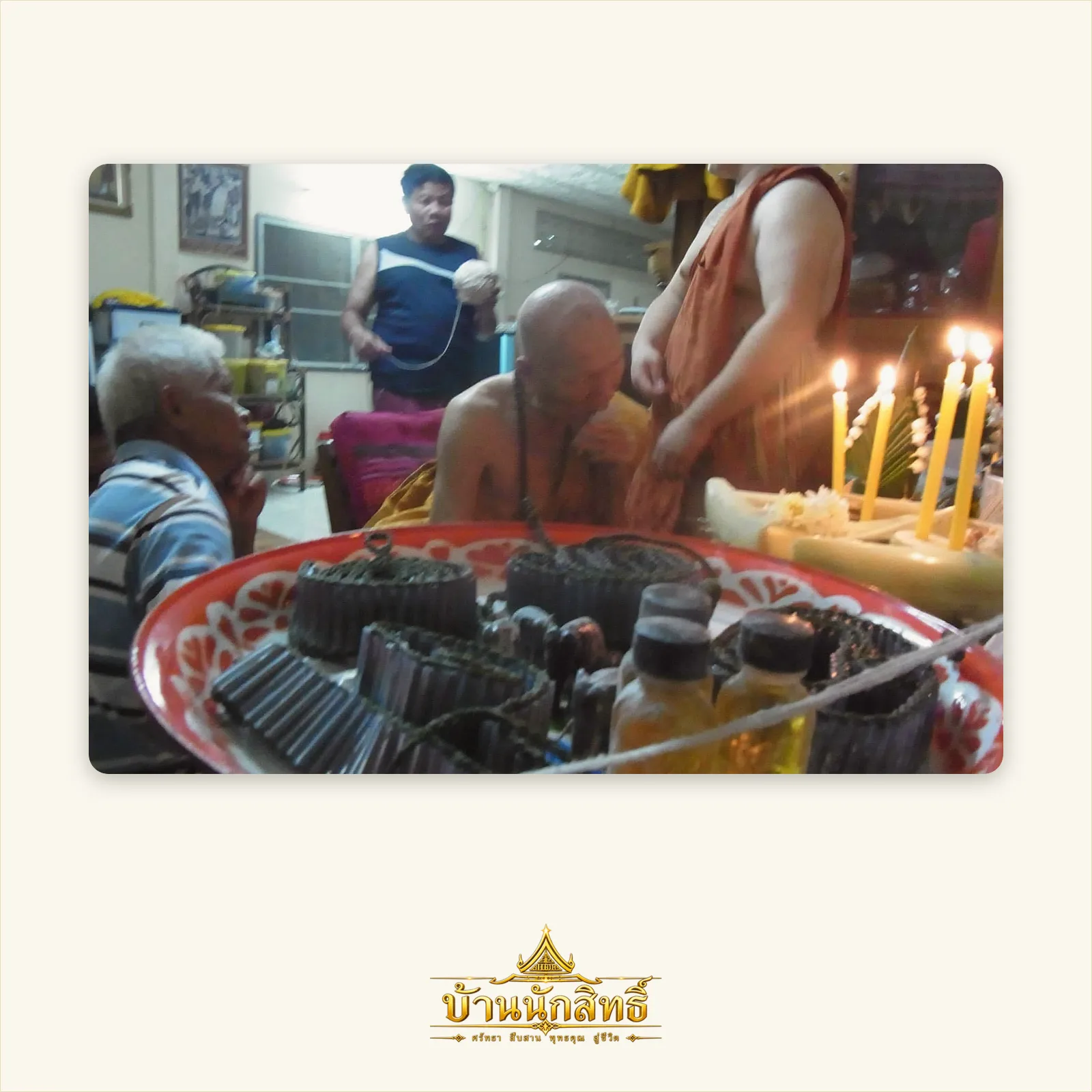
That night
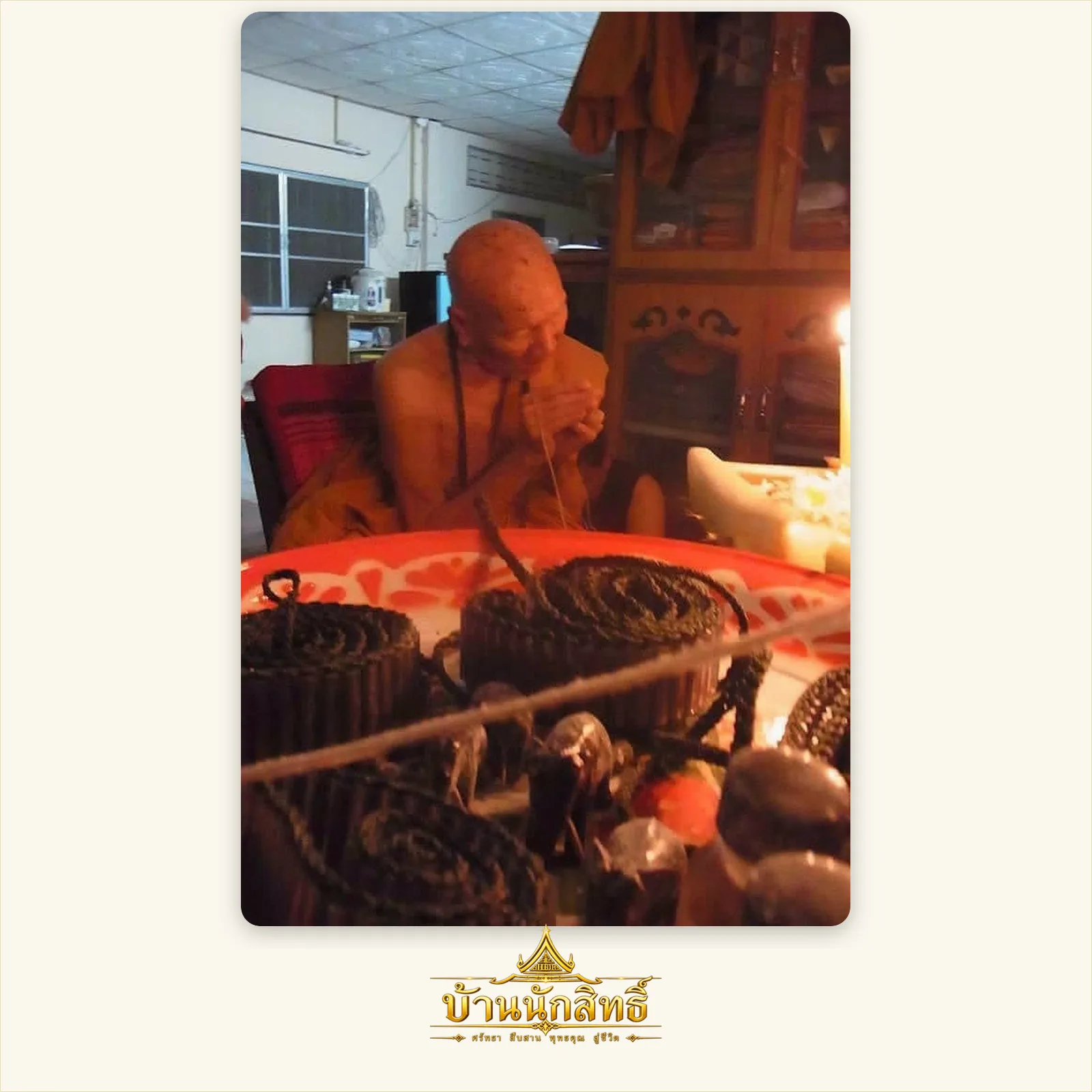
He blew the incantation into the sai sin
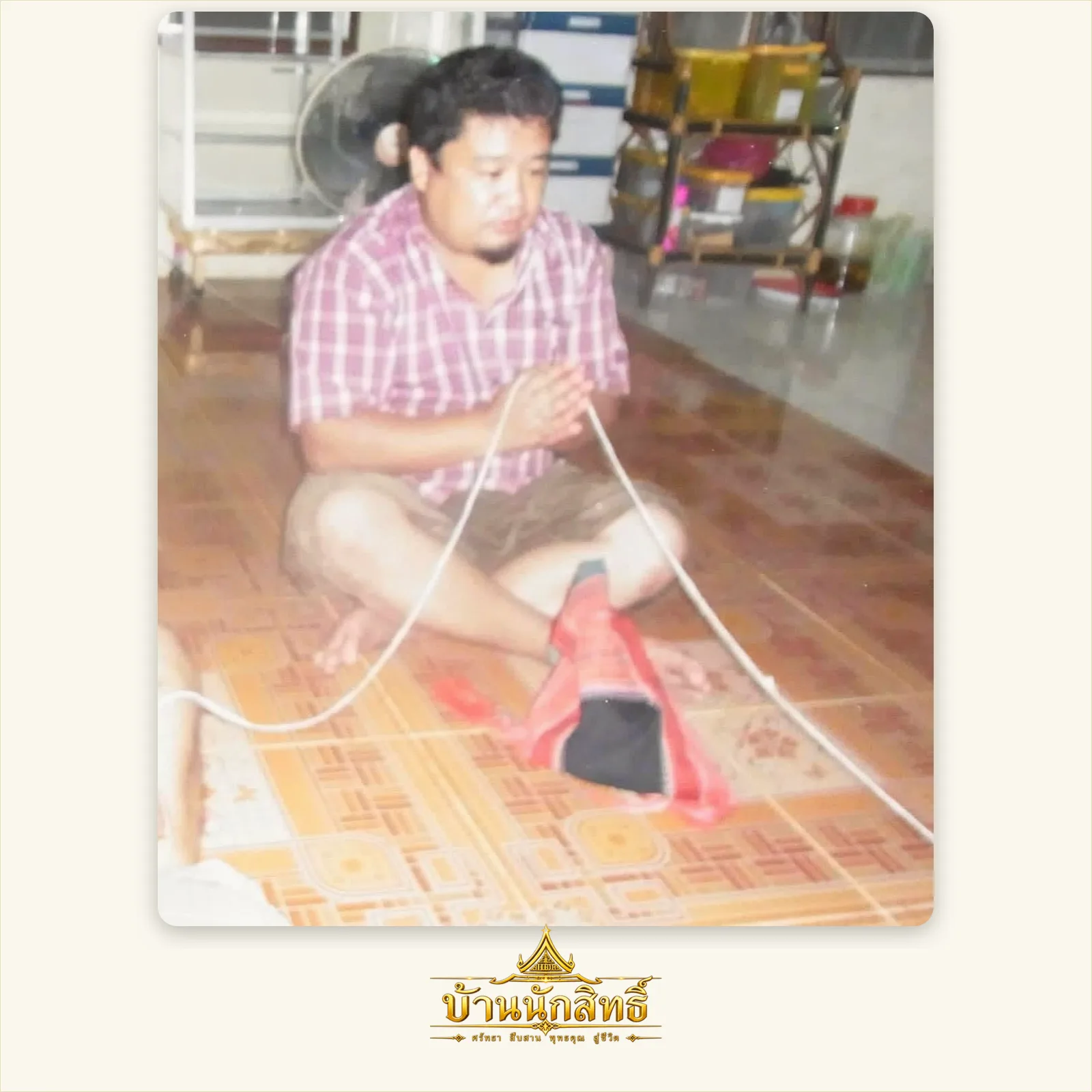
The sai sin that reached my hands
To learn a craft, first wash the brushes
When I consecrate things myself, I usually call my disciples to sit in consecration with me, because I regard it as training, as doing the work under the master's eye. I give each of them the verses suited to him for the work of consecration — usually the verses for establishing the elements, which are held to be essential. The binding verses that I took up and learned alone remain my own duty.
So to become anything at all there is a process, there is apprenticeship. Go to learn painting and you must first wash the brushes and sharpen the pencils.
If one buys a text and studies it alone, one may deceive others, because one only sits with eyes closed and memorises. The surrounding matters — how a pencil ought to be sharpened, how a brush ought to be washed — one will not know.
A man who has never kept a Wua Thanu — how should he make one? He who has never eaten kaeng rawaeng — how should he season it?
This Ai Kamphra horn bull I have enshrined myself, and had my companions try enshrining it too, and so found it to be another fine body of knowledge.
The instructions for use in Ya Than Phao's text
The Tuesday full moon just past is not a required auspicious time for making the bull of this tradition, yet the Tuesday full moon has become my own personal occasion for making bulls. On this occasion I performed the rite in the ubosot of the monastery of Luang Pu Khamdi Chantho (หลวงปู่คำดี จันโท), Yasothon.
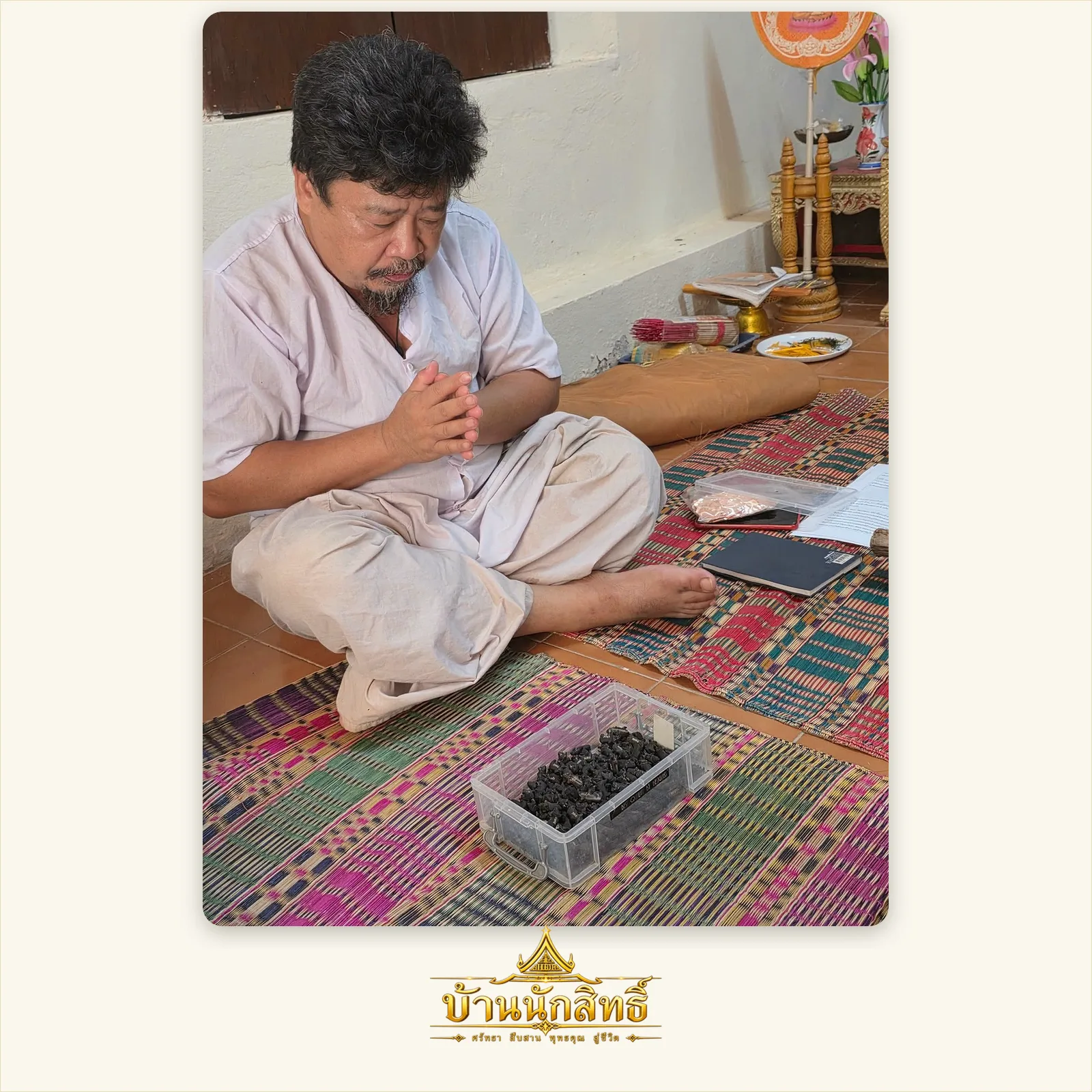
The Tuesday full moon occasion, in the ubosot of Luang Pu Khamdi Chantho's monastery, Yasothon
In the tale, the bull of this tradition was given to Thao Kamphra by Phaya In Sun for the wagers by which a city was contested; hence it is used for trade and for contest. The instructions for use in the text of Ya Than Phao that has come down to me read thus:
Though there be misfortune and danger, though there be enemies, phi hong, phi ha, phi pao, phi pa, or men, none shall be able to work harm. Should there be fever, aching head, dimness of eye or pain of the belly, steep it in water and drink, and long life shall truly be. And should one wish for wealth and goods in abundance, bathe it with som poi water and turn the bull's head toward the quarter in which one is going (to trade); one shall attain according to one's own wish, and return again to one's own home (travelling out and back in safety).
Turn the bull's head toward the quarter where you go to trade
The sense of it is like the cattle traders of old, or the nai hoi who went far off to trade: one turns the bull's head that way.
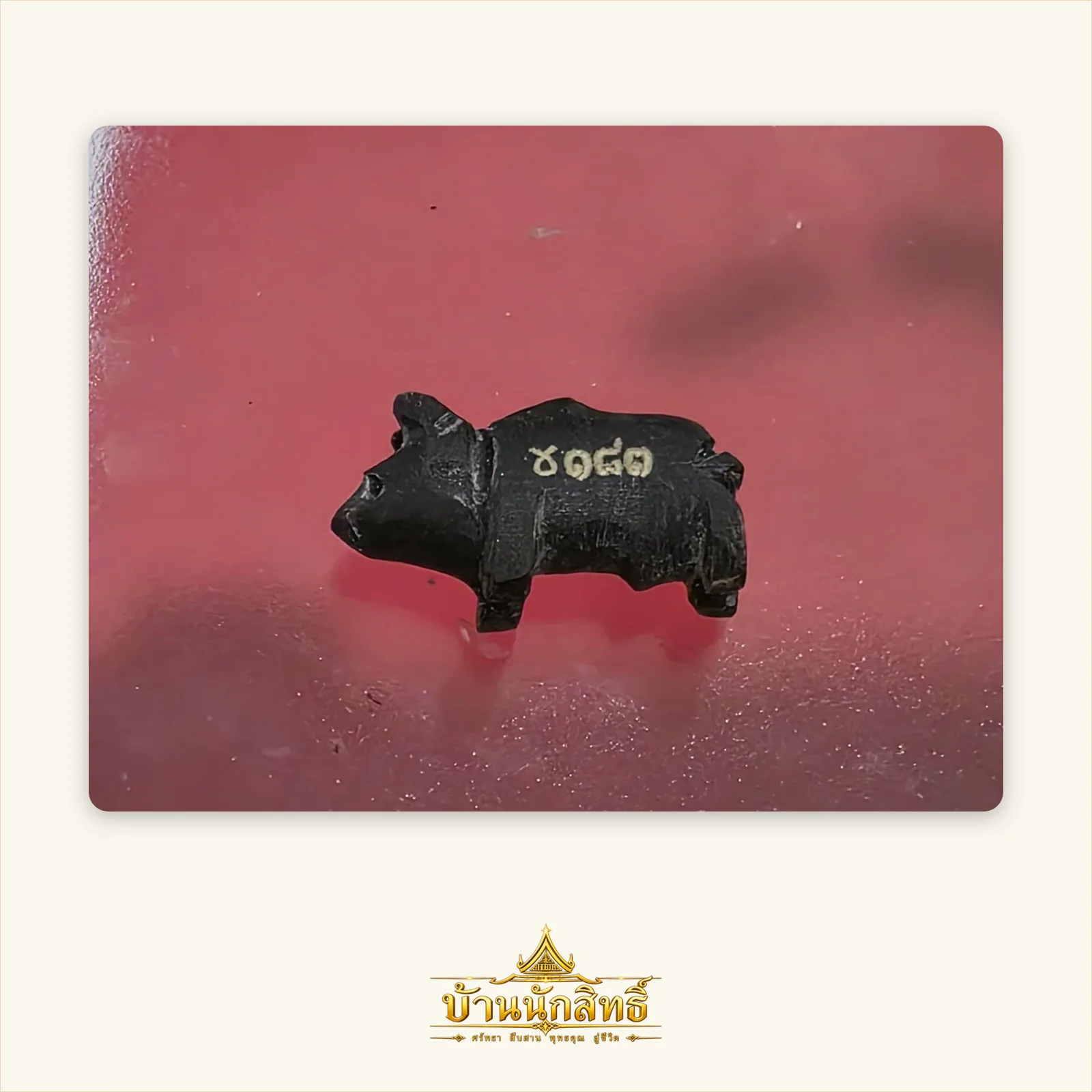
The script upon the body
Carried as a pair
Another point of interest: several texts direct that this bull be carried as a pair — the masters say a single one may be carried as well.
This tradition is not all-encompassing in its power (phan chong) like the Wua Khrang Phan Chong, but it suits a time of economic decline such as this. The masters emphasise carrying the bull of this tradition out to trade, principally for increase and prosperity, and it guards the bearer besides.
My hope is that in a time of hardship and high prices it may serve as strength of heart, a special support in the struggle for those we love.
Ai Kamphra Wua Thanu, Tuesday Full Moon occasion — consecrated in the ubosot of Luang Pu Khamdi Chantho's monastery, Yasothon. No elaborate procedures, a small making, no marketing. Anyone interested is welcome to enquire with the studio.
Note: the stories, texts and experiences in this article are what the author has seen and what has been passed down to him by word of mouth, recorded here as they are. They are in no way a guarantee of results.